
Pima MNs in the Field: Firefly Atlas Field Trip, Empire Ranch

Firefly Atlas field trip at Empire Ranch, Sonoita/ Las Cienegas National Conservation Area, June 25th, 2026 (partly cloudy w cumulous clouds, 84 degrees and falling, Humidity 44% +/-)
Childhood evening Faeries to Riparian/Cienega Canaries-in-the-mine, Fireflies hold our attention. A dozen Master Naturalists answered the call to gather at sunset to catch a glimpse of glowing abdomens.
PCMN Chris Robie organized this gathering as an event of the Xerces Society Firefly Atlas project. Entomologist and firefly aficionado Tony Palmer (Biological Science Technician at Tumacacori National Historic Park) presented us with Arizona firefly biology, habitat criteria, distribution information and citizen science observation/recordation strategies.
Populations of the Southwest Spring Firefly (Bicellonycha wickershamorum, BW) have been studied at this location. This species lives within 30 feet of running water in cat tails, sedges, and mints. Females lay their eggs near streams in moss and/or decomposing wood. During the mating season of June-July males fly over their habitat flashing to get the attention of females sitting within the tall grasses. Females, now heavy with eggs, flash a reply but do not fly.
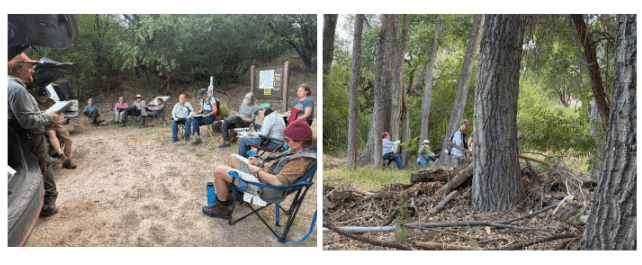
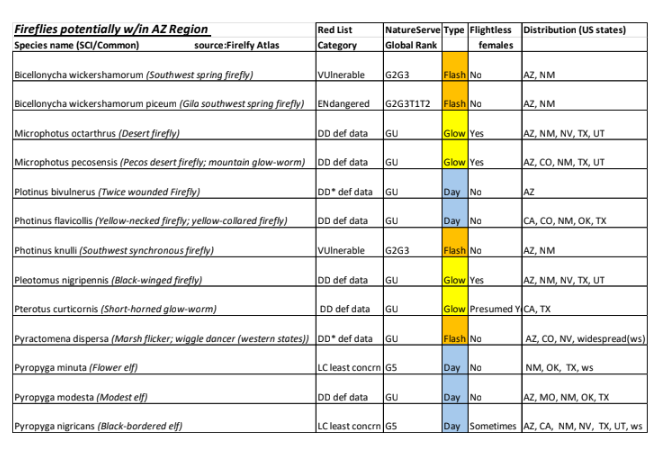
We sat in a semi-circle of camp chairs absorbing the fact that there was not one but 19 firefly species in Arizona! Our target species was BWs yet as citizen scientists we remain open to discovery of other kin (see Chart of some AZ species at end of this article). Tony guided us through the Firefly Atlas Data Sheet: observer, location, date, time, moonlight, cloud cover, sunset, moonrise, habitat, wind, temp, humidity, precipitation, and flash patterns-period/interval/duration.
As sunlight became golden, we scattered to riverbank niches. Sunset through the cottonwoods. Song of Yellow Billed Cuckoo. Soft human chatter. Sunset at 7:30 – Gibbous Moonrise ~ 8:00. Excited rustling when a few flashes were sighted. One caught in a net then held a moment on a palm. Fuzzy videos attempting to time flash patterns. Few males flashing this night maybe due to dryness of habitat or not interested in competing with the moon.
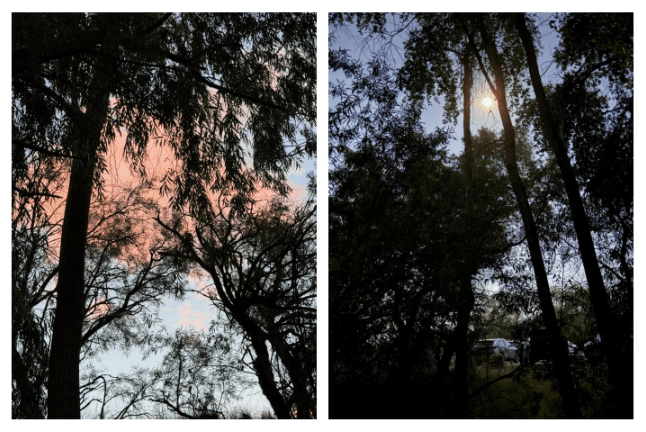
Fireflies, we see you more clearly! May we be aware of land/water use developments that endanger the existence of your home places.
Fireflies, thank you for inspiring Chris & Tony to gather us. MN Friendships were deepened in your presence.
A few Resources:
1. The Firefly Atlas (https://www.fireflyatlas.org/) is a Xerces Society project, working in collaboration with the IUCN SSC Firefly Specialist Group and New Mexico BioPark Society. And funded by https://bandfdn.org/
2. Silent Sparks: the wondrous world of Fireflies by Sara Lewis, Tufts University https://silentsparks.com/
3. Joe Cicero videos on YouTube: AZ Fireflies and Related Groups w Joe Cicero 2023 (https://www.youtube.com/watch?v=j5QlsSiBTRU); Coffee Break: Fireflies of AZ Sky Alliance 2022 (https://www.youtube.com/watch?v=ju7TW-hZT_c)
4. Guide to Fireflies of the Southwest by Anna Walker: https://www.fireflyatlas.org/wp-content/uploads/2024/06/Guide-to-Fireflies-of-the-Southwest_V1_Jun2024.pdf
5. Community acting to protect habitat: https://scenicsantaritas.org/
Article written by Michele Sheehan PCMN Cohort 10


You must be logged in to post a comment.