
Crested Saguaros: A Sonoran Desert Treasure
By Jane Hunter

In 2012, during a productive exploration of the Tortolita Mountains, Joe Orman, Crested Saguaro Society member, and a small group of dedicated trekkers, spotted a saguaro that was in its early stages of cresting. It wasn’t a particularly impressive crested saguaro, but every discovery of these rare specimens is exciting, and Joe was pleased to add it to the database maintained by the society. Because he was convinced that it would one day be a glorious specimen, Joe named the saguaro “Bound for Glory”.
The Crested Saguaro Society is a group of dedicated naturalists who volunteer their time and resources to learn about and share their observations of crested/cristate saguaros and other mutated cactus. They collect photographs and information about these unique cacti and maintain a database with images and other pertinent information. To protect these rare cacti, access to the details, including the GPS data, is restricted to a small group of society members, but the photos of the spectacular array of cacti can be viewed on their website.

More than ten years later, in Spring 2023, as an aspiring AZ Master Naturalist, I reached out to Joe to tell him about a crested saguaro I had seen while bushwhacking through a remote area of the Tortolitas with a friend. The society had no record of the cactus, so Joe arranged a visit to gather info and photos of the saguaro. Within minutes of arriving at the base of the beautiful specimen, Joe spotted another one, just a few hundred yards from where we stood, that neither my friend nor I had noticed. As a result of hunting for these unique cacti for many years, Joe has developed an uncanny ability to spot them, sometimes from miles away. On this trip, he spotted a rare ring crested saguaro that he named “Ruby Ring”. Just before driving off, he used his binoculars to take one last look at the ridge and spotted a new crested saguaro that he tucked away in his mind.

A year later, in April 2024, Joe reached out to arrange another visit. On a beautiful and challenging trek up a wildflower-covered hillside, Joe, Harry Ford, also a Crested Saguaro Society member, and I made our way to the new crested saguaro that Joe had discovered. As expected, it was beautiful. Next, we ventured across the hillside to visit “Bound for Glory”. Joe’s satisfaction as he gazed up at the majestic saguaro in all its glory against the clear blue sky was obvious. It was wonderful to see his joy and a special treat for me to spend the morning with this pair of dedicated naturalists.

Why I Wanted to Become a Master Naturalist
By Suzanne Wright

I first fell in love with the Sonoran Desert when my then-employer held a national sales meeting at the Boulders Resort & Spa in Carefree, Arizona. I was 24 and I was blown away.
Walking amid soaring saguaros, encountering a rattlesnake, hearing the staccato hoo hoo hoo of a great horned owl, experiencing blazing pink and orange sunsets, smelling the perfume of a monsoon-dampened creosote, craning my neck to the inky star-strewn night sky—it all felt surreal, like a movie set or a dream.
But being here also felt familiar and comfortable, which is rarely true for newcomers to a desert. I believe in past lives and I believe I’ve lived one, maybe more, here in the Sonoran Desert.
That indelible first impression was seared into my soul. And though I lived amongst skyscrapers in Atlanta for many, many more years, I returned to the Arizona desert as often as I could.
So decades later, when I finally uprooted my good life in Georgia, it may have seemed sudden to some, but it was really epochs in the making, in the dreaming, in the yearning, and finally, in the doing.
The Sonoran Desert embraced me and I embraced it. The Sonoran Desert has remade me.
My relationship with this fierce and fragile place is the most powerful and the truest I’ve ever known. Living here is not without drama—searing days, angry winds, unexpected snow, fearsome floods, the Bighorn Fire—but never turmoil of the human kind.
It’s drama that eventually heals itself and that’s been an ongoing teacher and a balm to me.
I build hours, days, weeks, months, years—this is my 13th year here—and ultimately, my new and improved life around being outside, exploring, pondering, learning. I find myself falling in love again and again and again in this lush desert, in every season.
I’ve always been curious, adventurous, observant, and capable. But never more so than here. I’m stronger and smarter, too. And surprisingly, more compassionate.
Because I make a living as a freelance writer, I’ve increasingly turned to telling stories about the Sonoran Desert, Arizona, and other regional Southwestern destinations. I’m passionate about the issues we face collectively in our ever-shrinking wilderness.
In my first year living in Cave Creek, I met a woman while hiking. She invited me over for a glass of wine. It was an upscale custom home that backed up to an arroyo. Out of the brush, a mama javelina and three reds the size of fat bread loaves ambled through the wash, their hooves clacking on the rocks.
This woman was immediately up. Cursing, she grabbed an empty glass bottle, and hurled it at the family, sending all four into a running panic.
I was stunned and saddened and enraged in equal measure.
I set down my glass, pushed back my chair, and began to speak, saying this was their land first, it was we who were the interlopers. How this was the behavior of any animal ensuring the safety of its young.
She dismissed me with her hand and something about her toppled flower pots.
I thanked her for her hospitality (I’m still a Southerner, culturally), but said I didn’t believe we shared the values required for friendship.
Then I left while her jaw gaped open.
That was the impetus to channel my fury into volunteering at the Desert Foothills Land Trust and the McDowell Sonoran Conservancy before I eventually settled in Tucson.
As more and more people move into the Sonoran Desert, there is a pressing and greater need to educate, whether formally or informally, in person or online, one-on-one or to groups.
There’s a necessity to debunk so many wrong-headed actions: trampling wildflowers for a selfie, building cairns, poisoning packrats, killing snakes, flooding yards with bright lights, feeding wildlife, going off trail, pulling native species, planting thirty grass lawns, decrying migrants.
Grrrrrr.
This is far from an exhaustive list. I’ve had endless conversations on all these topics and more.
Sometimes I’ve gotten a point across to someone or at least made them think. Other times, I can tell their opinions are unshakeable, their hearts are hardened. Regardless, I’ll continue to champion what I know is right and what matters now and into the future.
I relish a debate and I’m committed to continue speaking out.
It’s a good fight, a necessary fight. We need impassioned crusaders advocating for our remarkable place on the planet, our beloved Sonoran Desert. It feels like a duty. Like a purpose. Like a calling.
The efforts matter. The results matter. We make a difference.
Titles have never mattered much to me; I long ago tossed my college diploma. So the paper certificate I’ll be awarded for my course completion isn’t the reward.
Being a Master Naturalist is a fast-track to creating greater awareness, changing hearts and minds, and plugging into a community of like-minded souls. When my energy flags, I need to be surrounded by and inspired by the many others who share my desire to safeguard the place we call home.
In the spirit of the raven, I’m proud to crow about being a Pima County Master Naturalist.
Critter Camp 2024
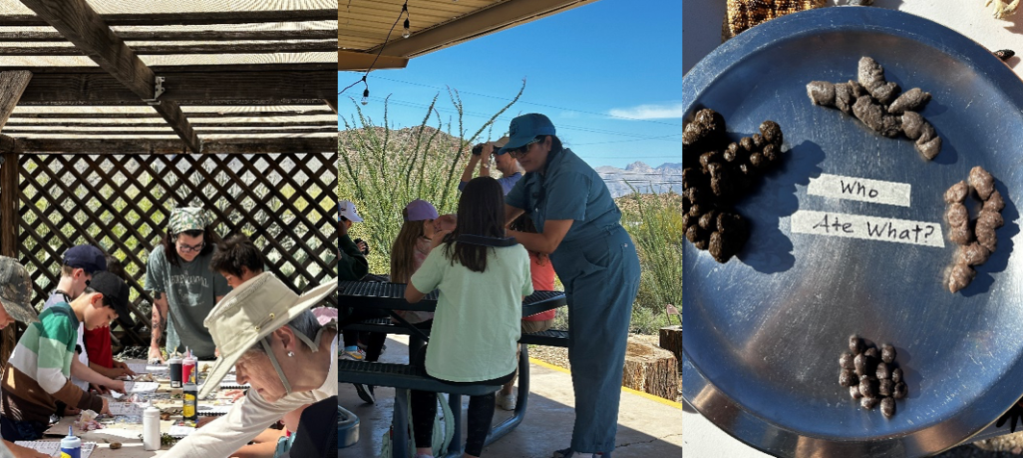
Our Pima Chapter Community Partner, the Cooper Center for Environmental Learning, hosted their annual Spring Critter Camp on March 11-12. The Cooper Center site is situated on 10 acres of pristine Sonoran desert land, 7 miles west of downtown Tucson. Julie Concannon, Jane Hunter, Jack Brooks, and Justine Hernandez from Cohort 8 and Summer Marshall from Cohort 6 volunteered and assisted with planned outdoor programs for the Sunrise Drive Elementary school student group. Fun and educational activities included mixing pallets of the desert, learning how to use binoculars, and how to identify tracks, skulls and scat. The students surely had an unforgettable outdoor nature experience. – Intro Deb Petrich, Cohort 1
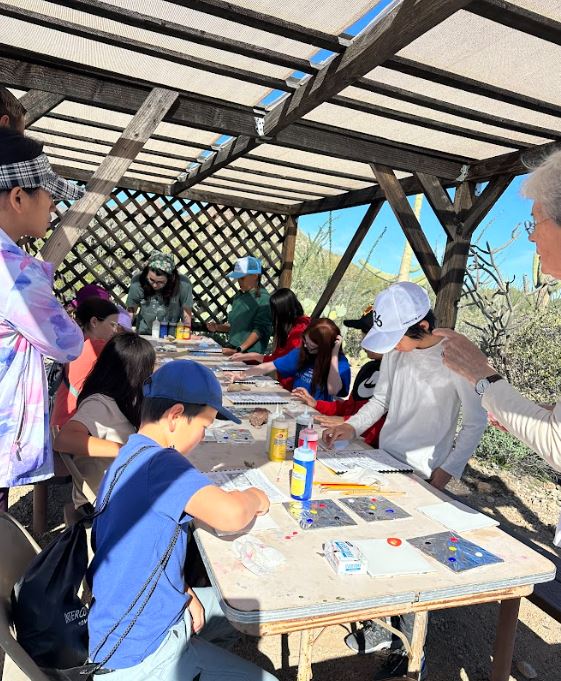
Volunteer Experience and Photos contributed by Julie Concannon, Cohort 8: Sunrise Drive Elementary School held Critter Camp at the Cooper Center on March 11-12. Justine, Jane, Jack, and Julie from the newly-minted Master Naturalist Cohort 8 showed up to help out. We completely enjoyed our time with the classes from Sunrise School. There were several classes at this camp. One of the classes was a Chinese Immersion Class. The kids were pretty surprised when I greeted them in Mandarin (Ni hao’). You never know what skill you are going to use from your Master Naturalist Bag. There were three stations for us to handle. Jack volunteered for Mixing Pallets of the Desert Class. I had never seen this activity before and went to observe them. The activity of mixing colors to achieve desert colors made my fingers itch to do art. Justine was selected to help with teaching children how to use binoculars-and bonus, she got to work with the researcher from Tucson Bobcats. Those children spent time looking for Bobcat kittens on the adjacent mountain next to Cooper Center. I ran the Skulls and Scat table. It is pretty amusing to watch the kid’s faces when they finally realize the scat is rubber and that they could touch it. I told my friends that “I was likely their only friend who had scat on their countertop.” They replied “certainly the only one that was proud of it.” Critter Camp was a really fun volunteer opportunity.
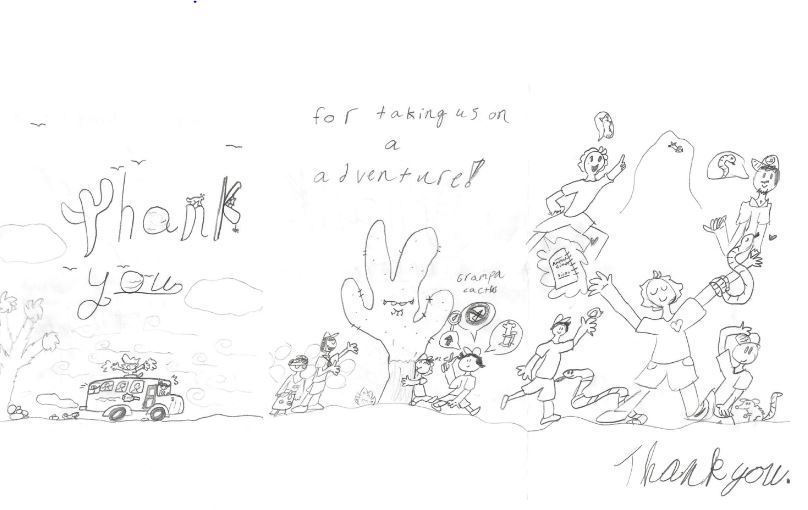
Charlotte Ackerman, Catalina Foothills STEM Integration Specialist, created a file of pictures from the field trip for our viewers and naturalists to enjoy. In addition, she scanned thank you notes from the students that referenced their activities and some that expressed the students’ enthusiasm for the day so well. Charlotte noted: ‘…they are all still talking about it! Thank you to all for the help.’ Thanks to Peggy Ollerhead, Cohort 3, for providing Charlotte’s comments, photos link and thank you notes.
Camp Cooper Thank You notes
Tucson Festival of Books March 9-10, 2024
The Pima County Master Naturalists (PCMN) have been watching folks take delight in a beautiful mesquite box full of scat for years. No matter where we are, people make a point of trying to figure out which animals call the places they are visiting in the Sonoran Desert home, based on what they leave behind. So when the opportunity to participate in the Tucson Festival of Books on March 9-10, with over 180 local and national exhibitors, we were thrilled!
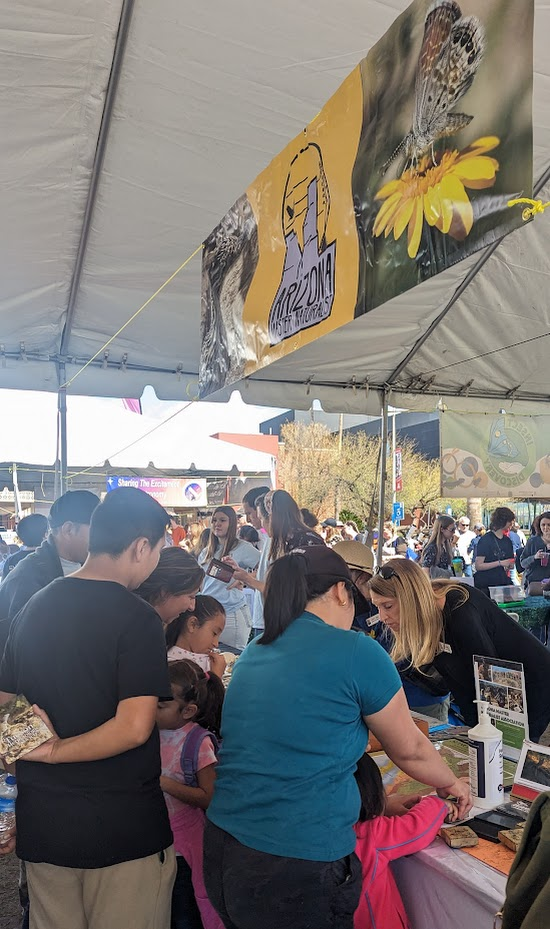
Everyone who chats with the master naturalists at an event has a story to tell and it most always delights. They reveal the name of their favorite 4th grade teacher who introduced them to owl pellets, the ‘gift of scat’ the bobcats leave on their patios and the enchanting call of the coyotes they hear but never see. This year at Science City, a part of the Festival of Books, all of us who volunteered, had a story of our own to tell about how folks are charmed by our wild spaces! By partnering with Pima County Parks and Natural Resources, we were able to include track activities, including a kinetic sandbox with track molds, and a pocket-sized take-home field guide using stamps of the tracks of some of our most familiar desert critters.
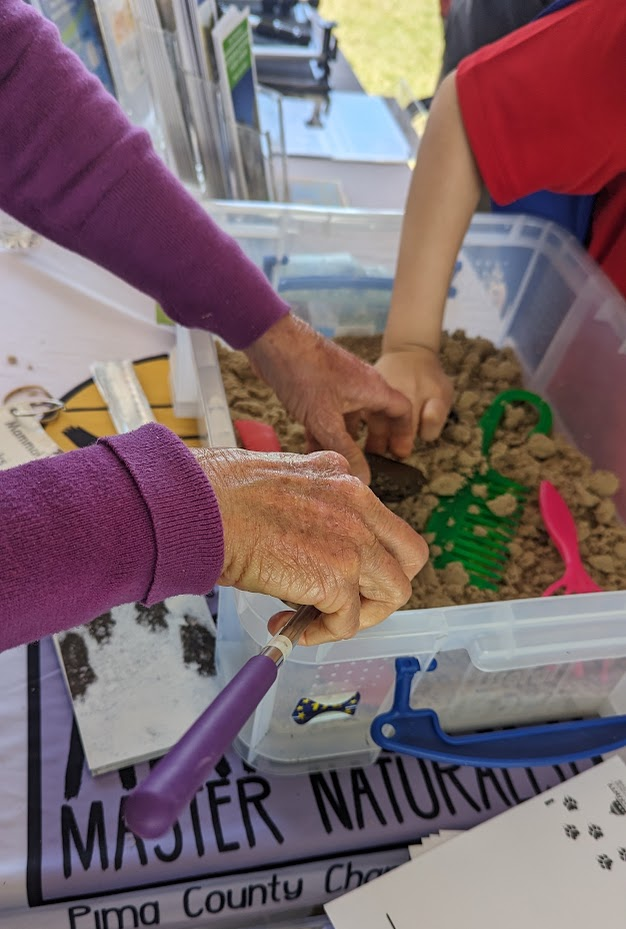
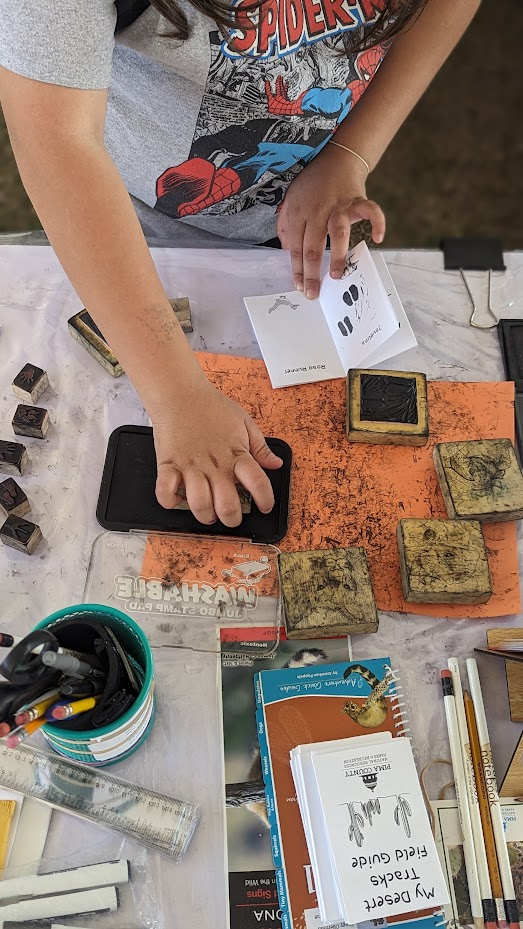
We distributed over 400+ field guides in two days to both Tucson residents and out of town visitors. Every individual left with a better appreciation of who else shares our trails, arroyos and wild spaces and the newfound knowledge of how they might identify even those critters they will not see.
As a multi-day event, the Tucson Festival of Books required a team of volunteers. Many thanks to the following folks: Jenna Marvin C3 (who wasn’t able to attend in person, but folded over 500 field guides) and Melissa Mundt, C5 and Course Coordinator, who helped with logistics, copying and gathering materials. Saturday’s team of volunteers (captained by Peggy Ollerhead C3) included Andrea Hoerr C3, Chris Robie C6, Linda Dugan C5, Penny Miller C2, Linda Doughty C6, Dana Hook C6, and Jan Schwartz C4. Sunday’s crew was captained by Izetta Feeney C6 and included Sue Robertson C8, Rita Hartman C8, Francesca Ziemba C6, and Summer Marshall C6.
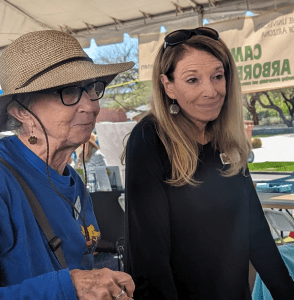

Post and Photos Peggy Ollerhead, Cohort 3; photo of F. Ziemba from Dana Hook ,Cohort 6
Wild at Heart: Burrowing Owls Thriving in Their New Home
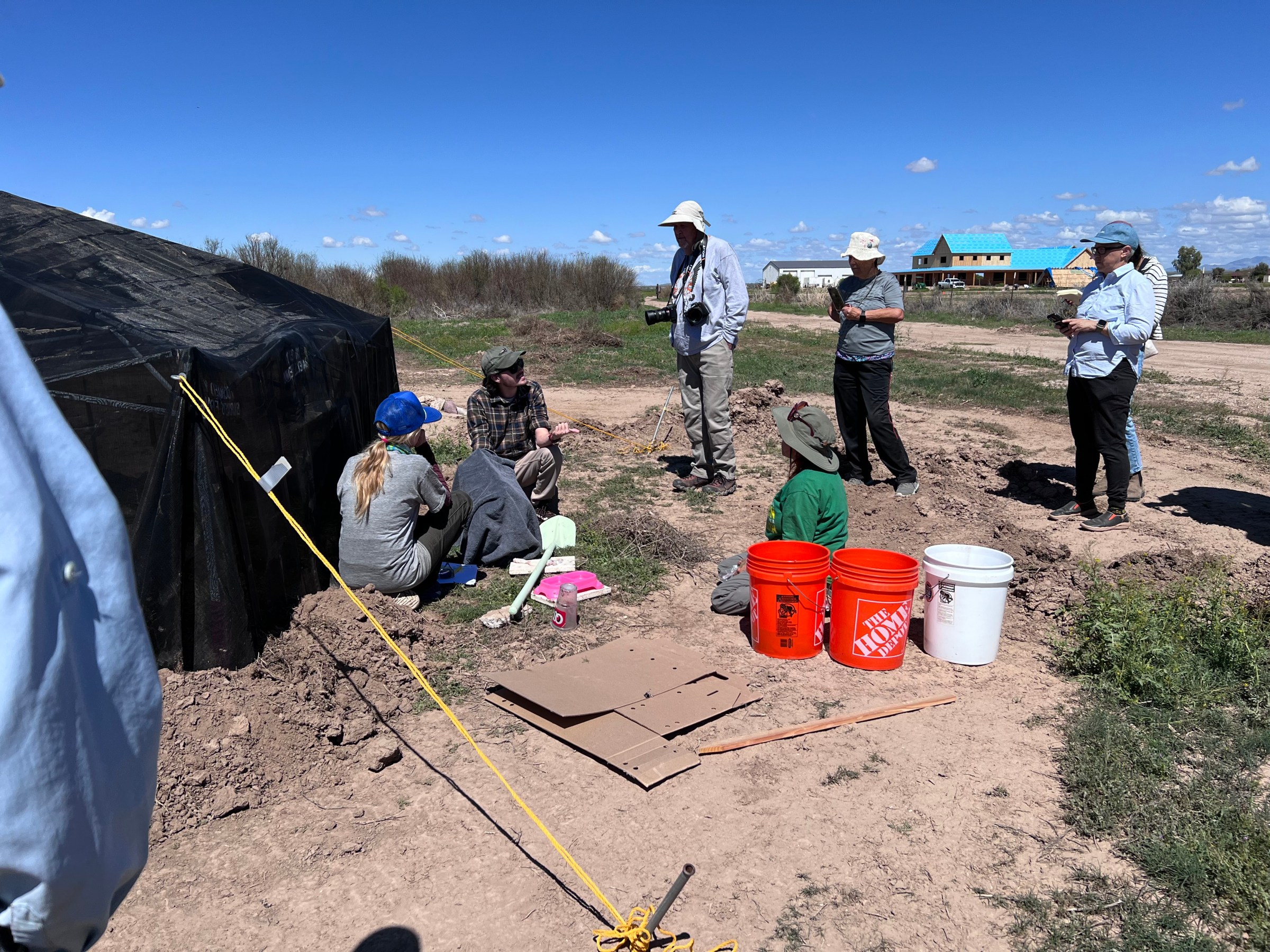
Post and Photos by Jane Hunter, Cohort 8
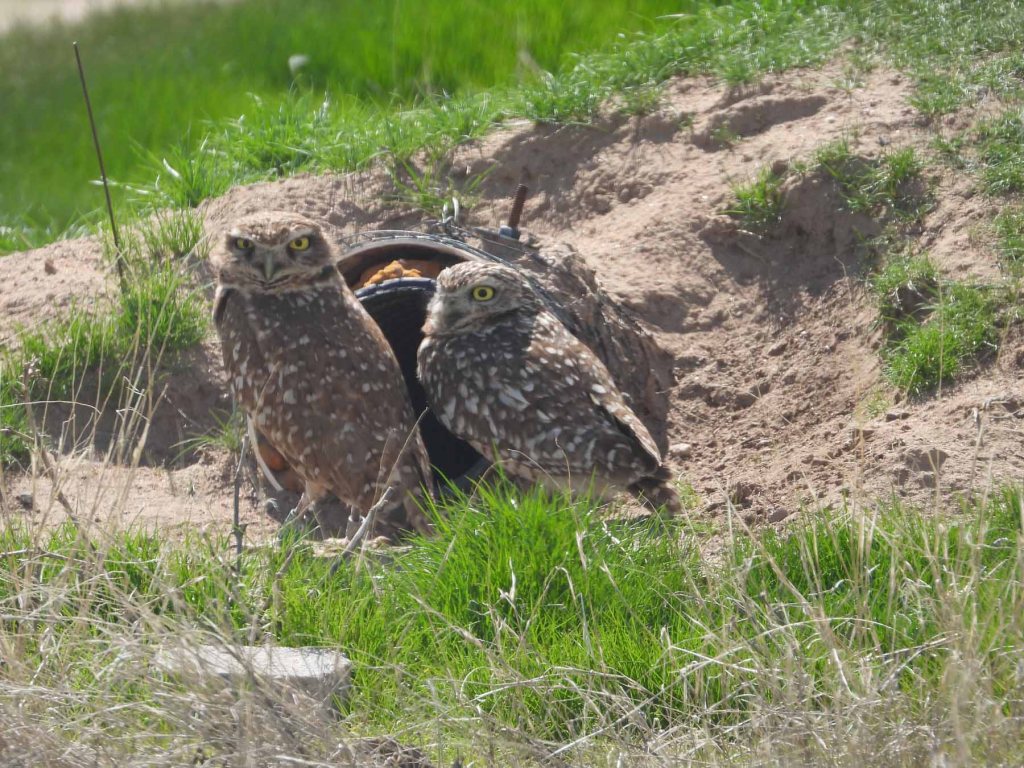
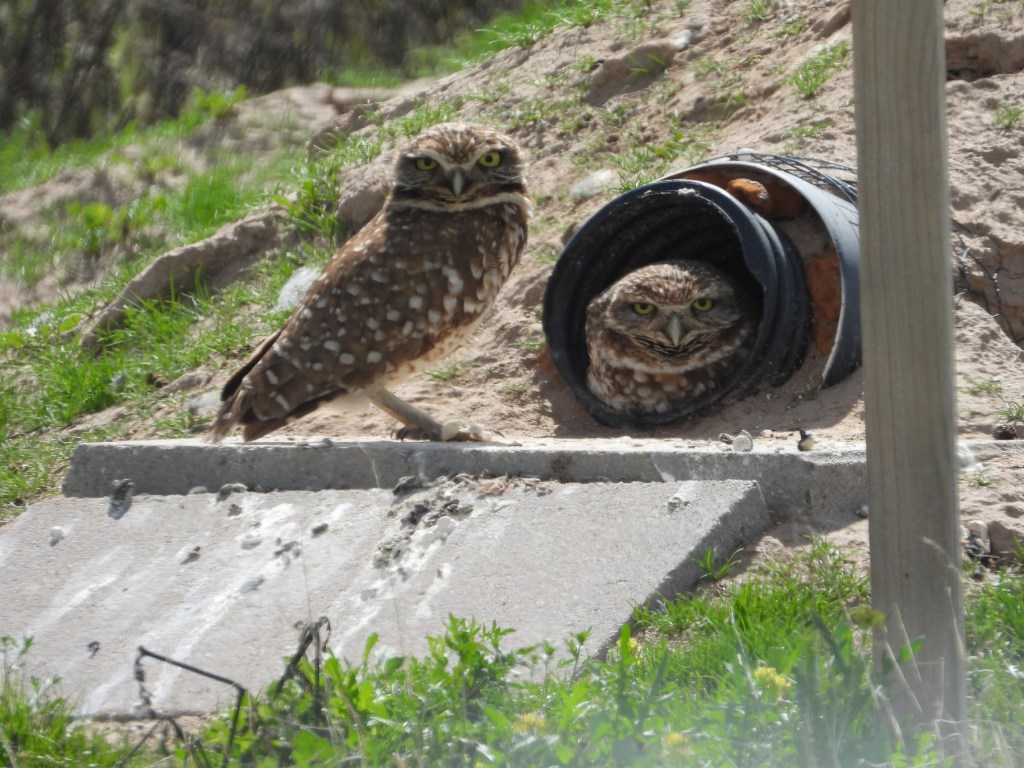
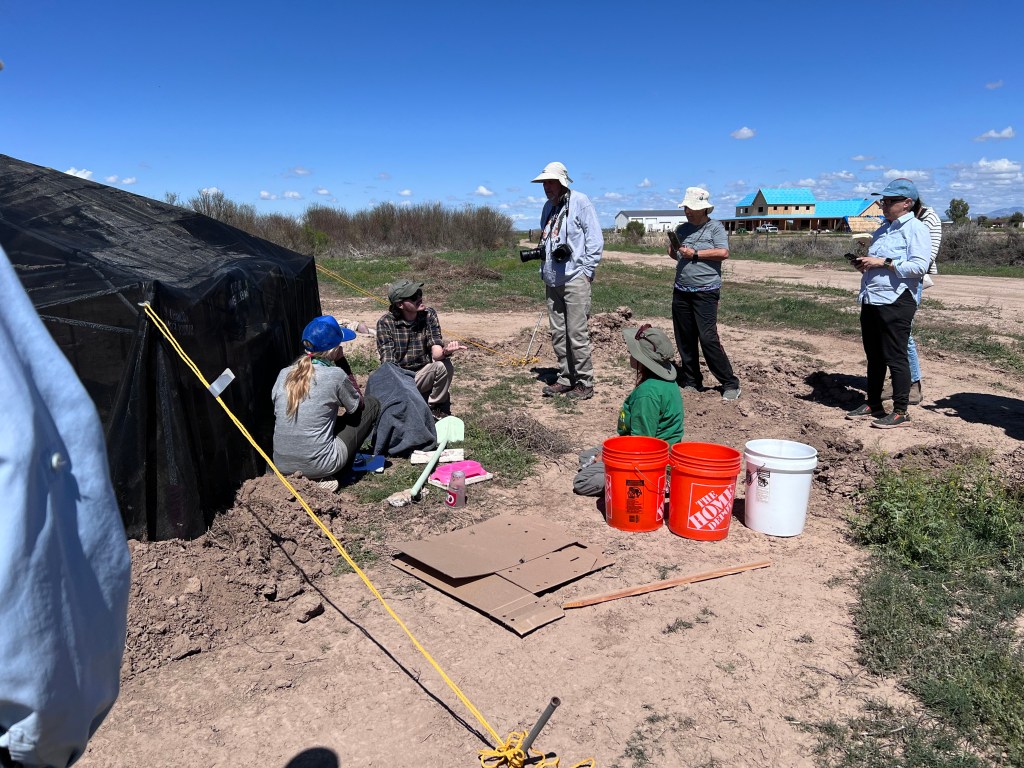
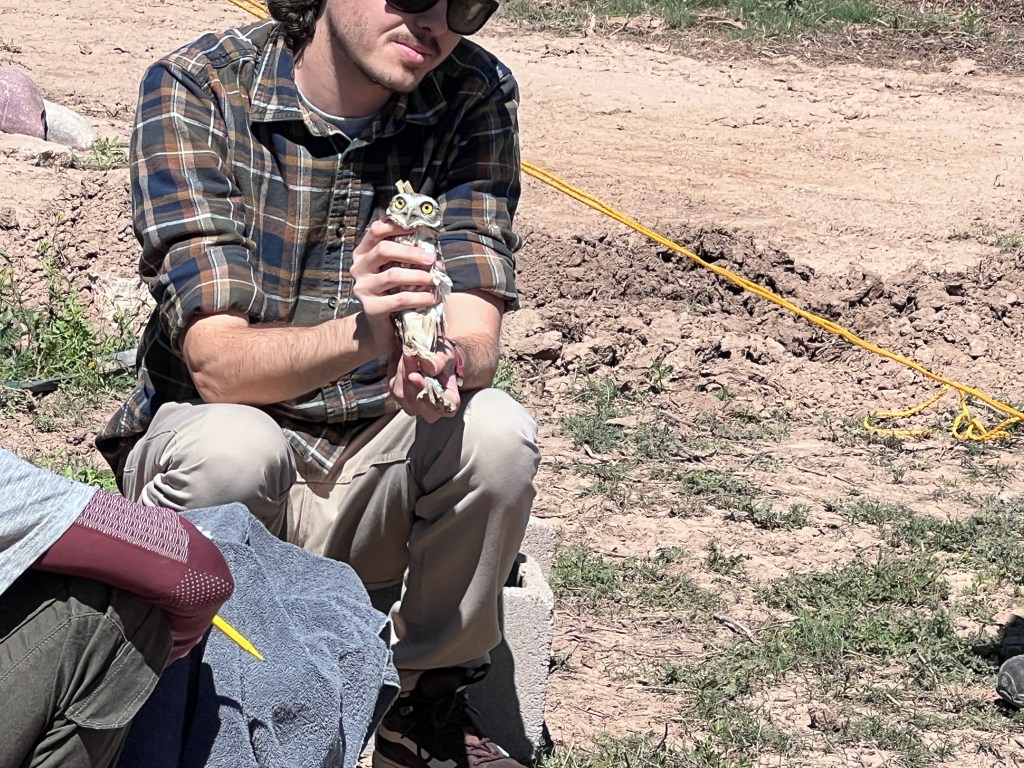
Early each day in mid-March, Jean Boris, Arizona Master Naturalist, Pima County Chapter and volunteer coordinator, checks the schedule to see who will be feeding the owls that day. She also touches base with Greg Clark, Wild At Heart’s Burrowing Owl Habitat Coordinator, to discuss any issues or concerns that need to be addressed. She contemplates taking the day off, but instead straps on her boots, packs up her car and heads to the Martin Farm in Marana to check on the colony of burrowing owls that have been relocated to the farm. Like so many other dedicated volunteers, the owls, although primarily adults, are her “babies” and she is willing to do anything to keep them safe and healthy.
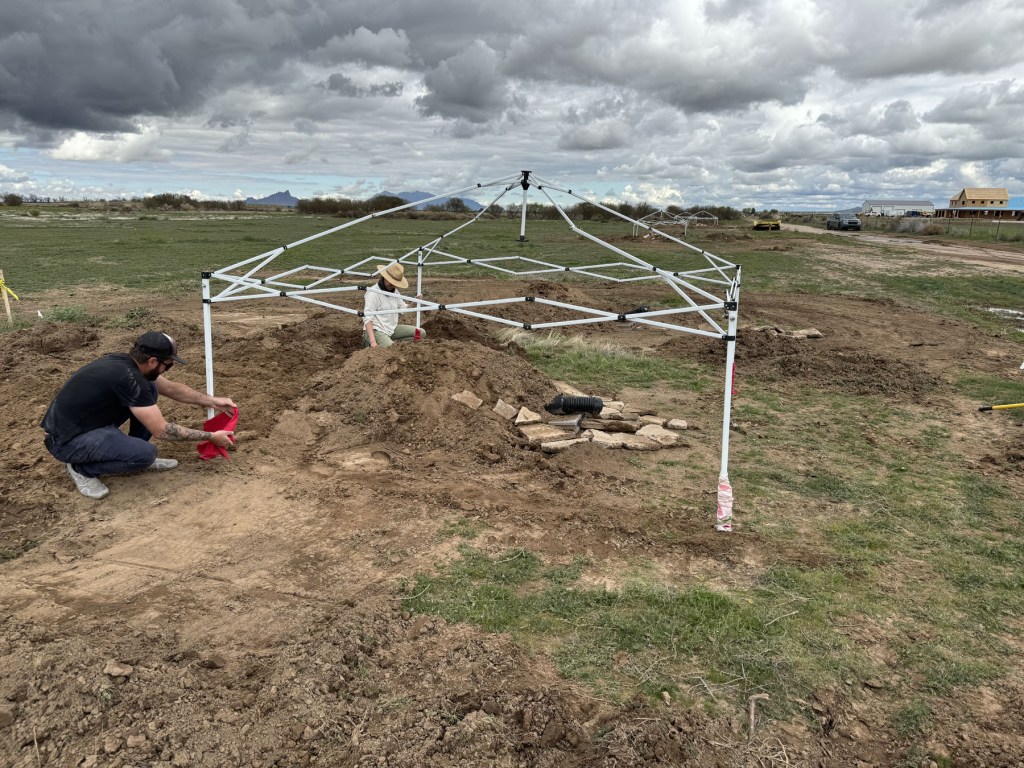
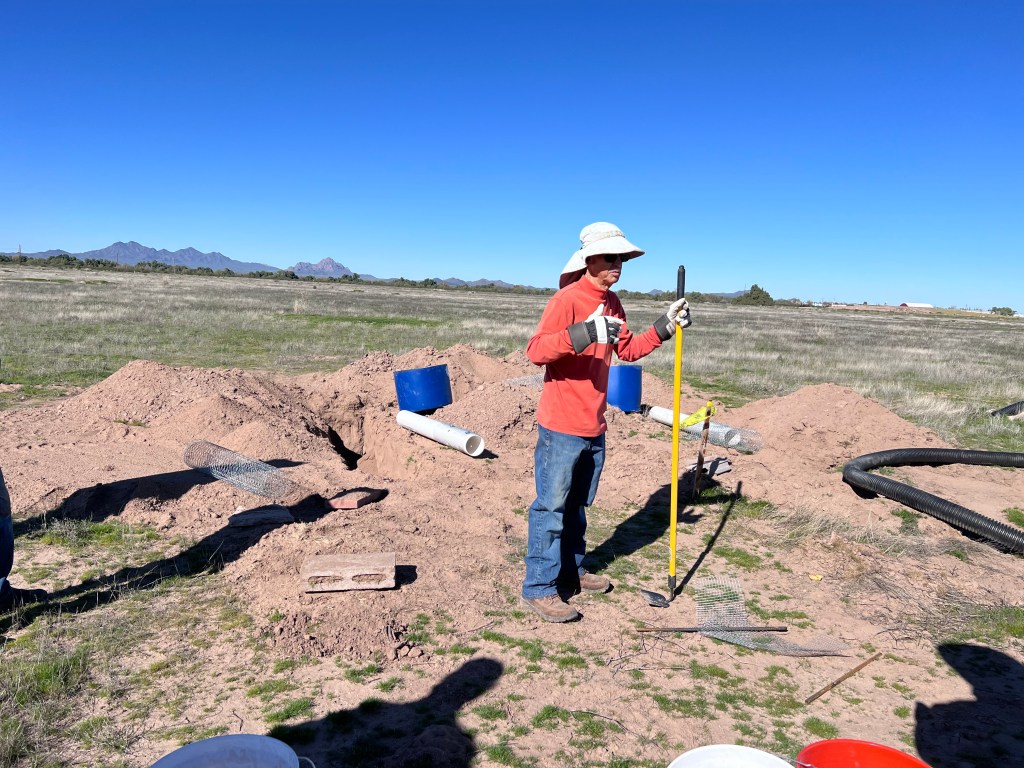
Burrowing owls are the only known species of owl to live and raise their young underground in burrows abandoned by squirrels, kangaroo rats, coyotes, foxes, skunks, and badgers. The new home for these owls that were displaced by development in the Phoenix area, is a field of 25 tents that were built by a large crew of volunteers, many of them AZ Master Naturalists, masterfully managed by Greg Clark who is eminently qualified to lead this complex and sometimes challenging project.Greg’s qualifications are too numerous to describe here, but you can learn more about Greg and the project at: Wild at Heart Burrowing Owl Relocation Project.
The support of Jean and nine other Pima Master Naturalists has been instrumental to the success of this project. Next year, when the invitation to support the project is posted, “run, don’t walk”, to sign up. It will be a tremendous experience that you will never forget.
AZMN Association Annual Conference, January 27-28, 2024
Contributions and Photos: Juanita Armstrong-Ullberg, Maricopa Parks Chapter Sponsor; Dana Hook, Pima Cohort 6; Deb Petrich, Pima Cohort 1
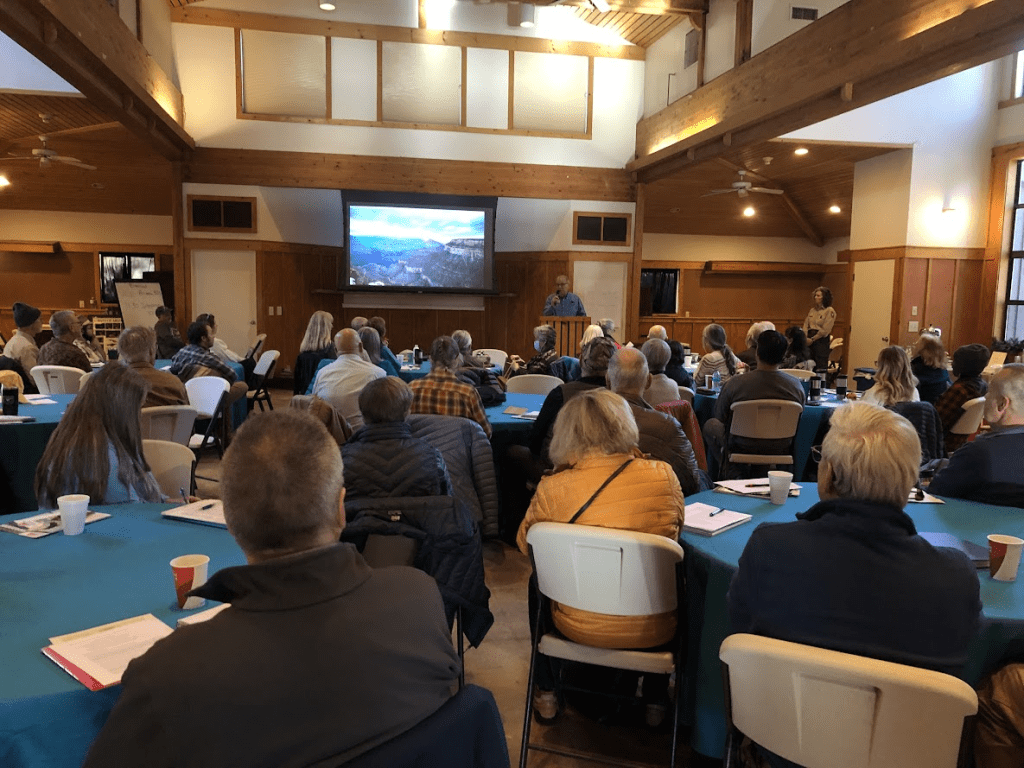
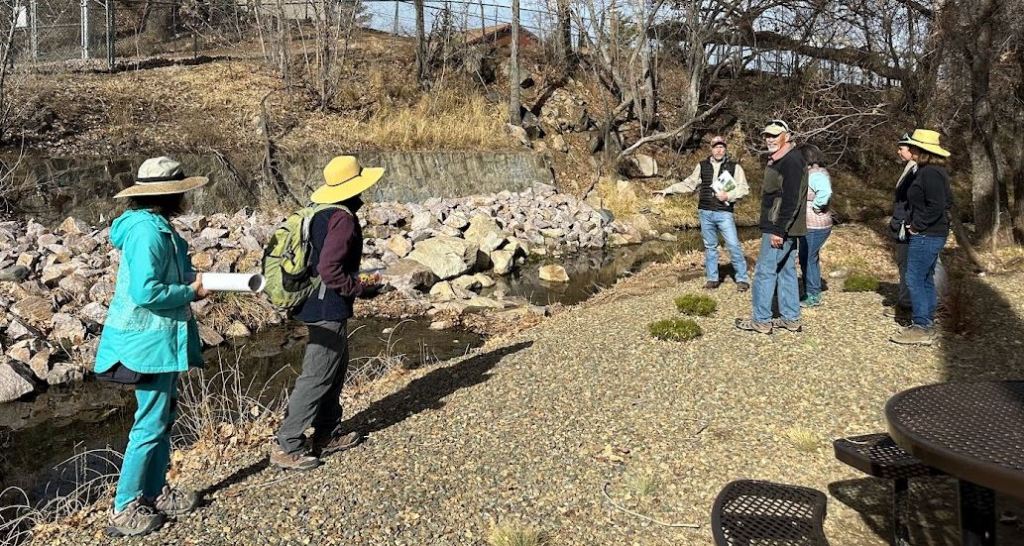
Post from Deb Petrich, Pima MN Chapter: This year the Central Highlands Chapter hosted our Arizona Master Naturalist Annual Conference up in beautiful Prescott, Arizona (the Pines), with well over 50 participants from all 4 Chapters: Borderlands, Central Highlands, Maricopa and Pima. This was a chance for our naturalists to meet new members, learn about the cultural and natural history of the Central Highlands region (session presented by Maria Icenogle, Education Director at the Highlands Center for Natural History and Chapter Advisor), then attend such diverse breakout sessions ranging from bats, to outdoor school habitats, to the history of the Yavapai people, to a character re-enactment from Prescott’s original mining settlement and more! On Sunday members could attend a morning session with Noel Fletcher, a Retired Wildlife Biologist, whose presentation discussing, comparing, and contrasting public land management agencies, policies, priorities and natural resource management in Arizona was very enlightening. Afterwards, naturalists were able to participate in several field trip options including an indoor tour at the Museum for Indigenous People or the Natural History Institute. Otherwise, naturalists headed outdoors to learn about the geology of the Granite Dells, explore the gardens and trails at the Highlands Center for Natural History, or learn about the important preservation work (and see murals!) on Granite Creek.
Post from Dana Hook, Pima MN Chapter: If you were unable to attend the AZMN conference in Prescott, you missed a wonderful, educational, friendly, and fun event with more than 50 environmental geeks from around the state. The conference was well organized, and I learned so much at the sessions. They brought in retired professionals from the National Parks, the Forest Service, and from Game and Fish. I really appreciated the leader from the Prescott Yavapai tribe that spoke to us about their history, culture, and vision for the future at their reservation and beyond.

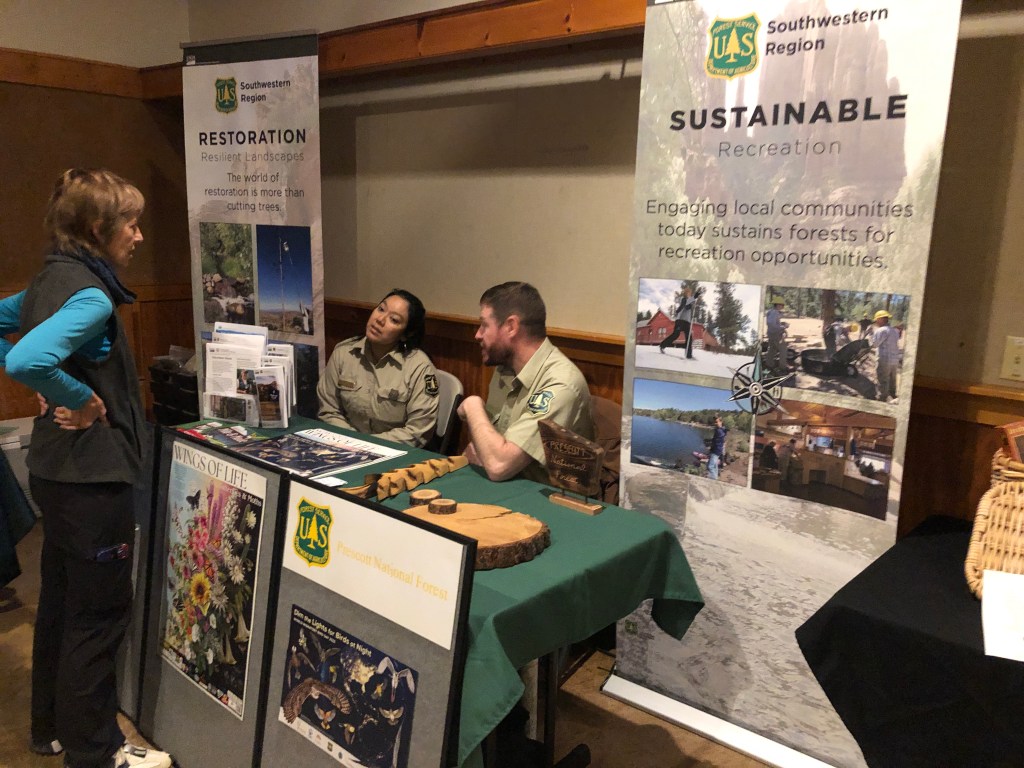
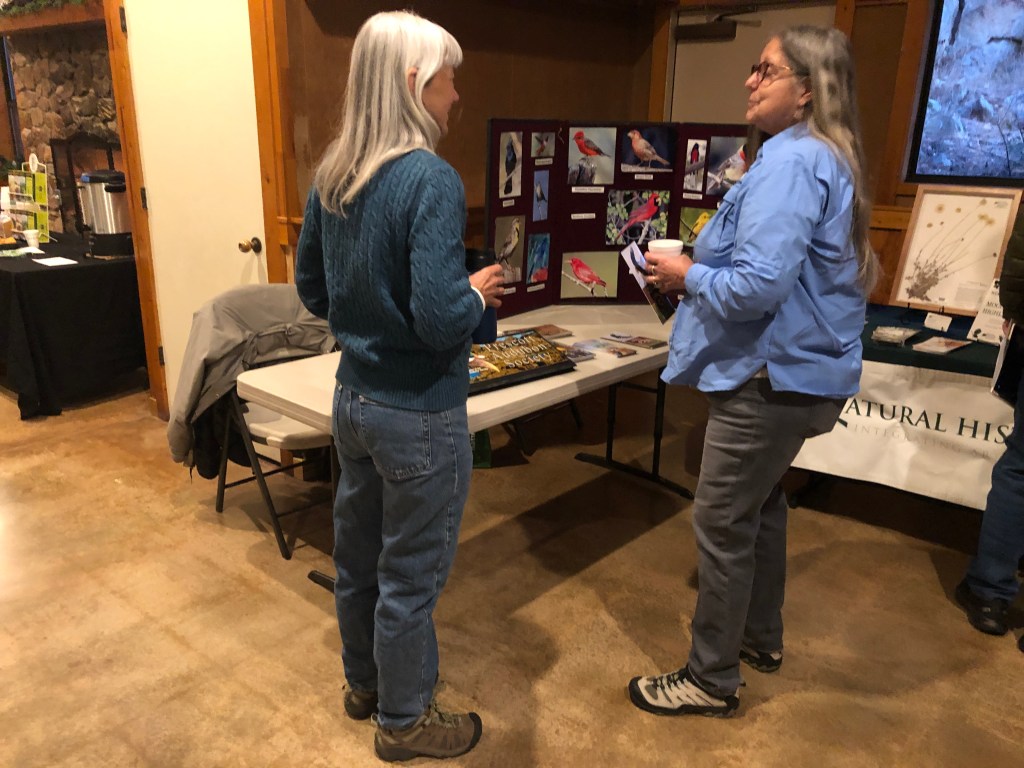
The Sunday field trips ranged from a geology hike in the Granite Dells to museums. They were also led by professionals that helped us understand in more detail the history and prehistory of the Upper Highland region. The conference is held each year around the state, and in 2025 it will be help in the Maricopa Chapter region, January 23-25. Save those dates in your calendar and join your fellow naturalists there.
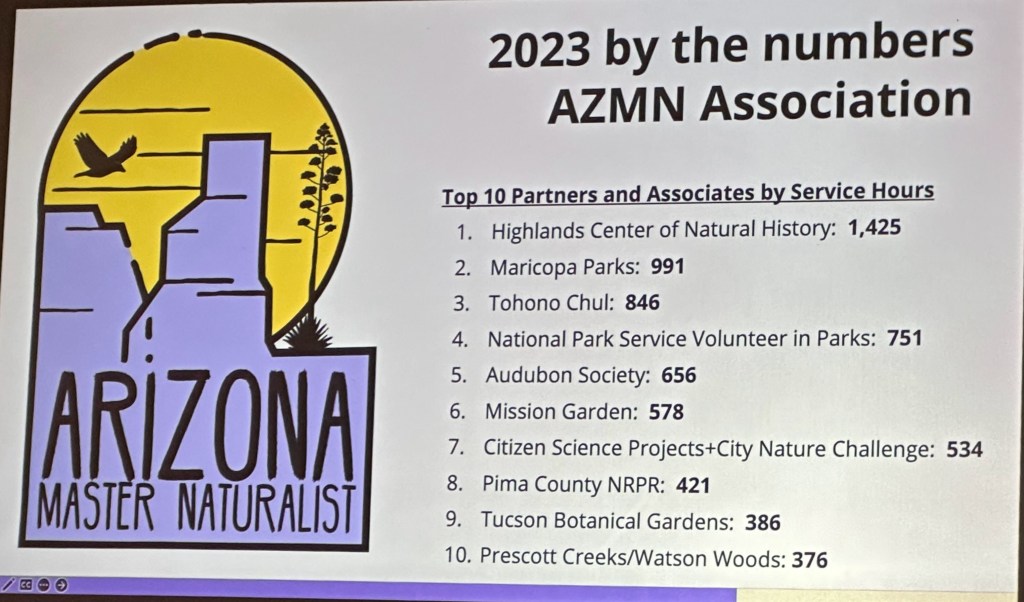
This was the 10th anniversary of the AZMN Association. Our Chapter will celebrate our 10th anniversary in 2026 and we will more than likely be hosting the state conference that year. We are the oldest chapter in the state, and we want to continue to grow and thrive. Through our eight years of existence, we have provided 41,000 hours of service to the environmental community. This year, I hope that together we can reach 50,000 hours of accumulated service. There are so many ways to volunteer as citizen scientists, environmental educators, and stewards of the environment. Let’s continue to get together, learn more, give more, and play more as a community of environmental geeks.
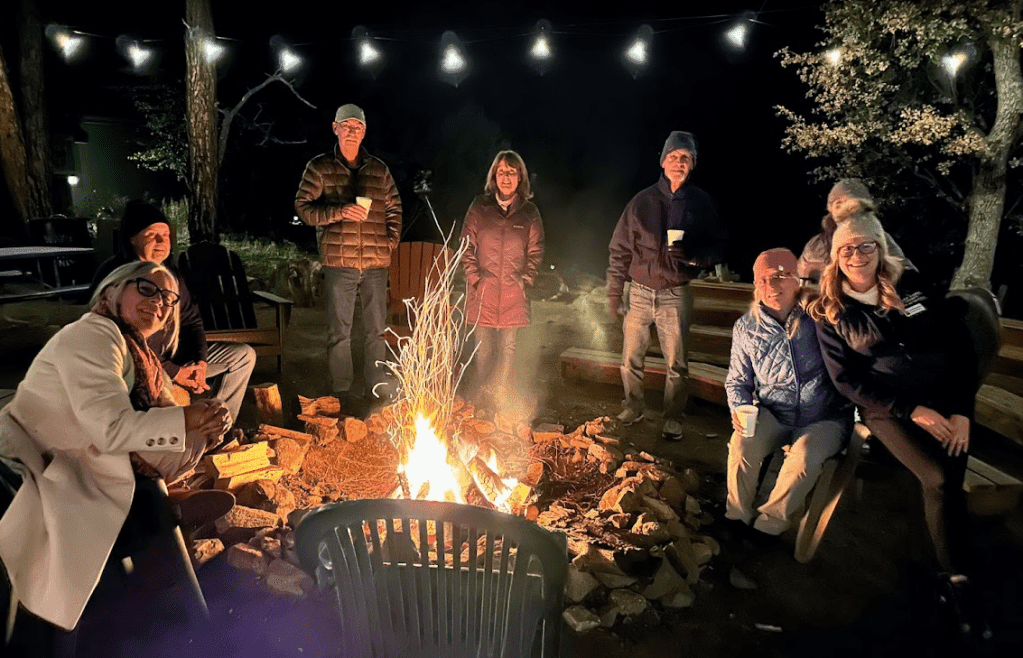
Post from Juanita: The Central Highlands Chapter put on an amazing conference. It was a great location and provided us with much time to spend learning all about Arizona’s natural history, biodiversity, and geology, but we also spent time getting better acquainted with one another and our fellow chapter members. You know what they say. “You can learn something new from everyone,” and this is so true. So to all of you who made it to the conference- It was wonderful to spend time with you; we had some great laughs and shared great ideas. I hope you learned much about our great state and its ecological communities, geology, natural history, and geology. I sure did. The keynote speaker had a fantastic presentation and was so knowledgeable about natural history and geology!


We also had a great fireside chat with many coyotes howling nearby.
I wanted to share with you all an amazing experience we shared together. Have you ever seen an Acorn woodpecker? We were excited to view this amazing bird; its chatter sounded like heckling ladies; they were on the conference grounds, and we got to see firsthand the acorn woodpecker stashing in action; it was really amazing to see how many acorns were stored in this one Ponderosa pine.
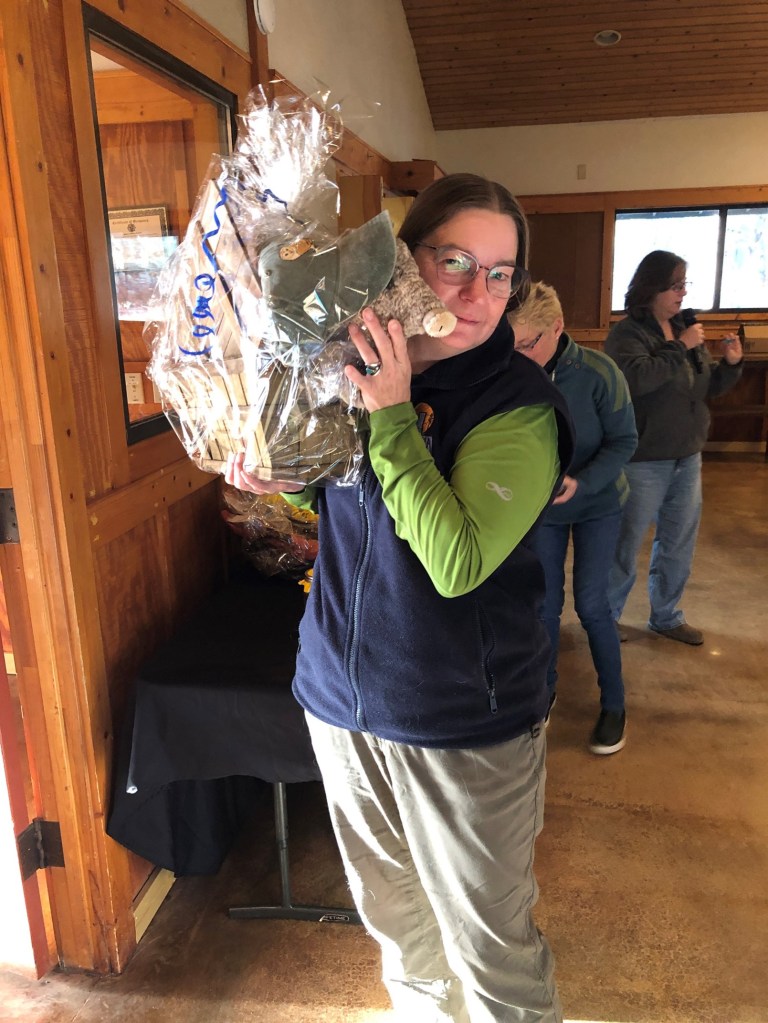
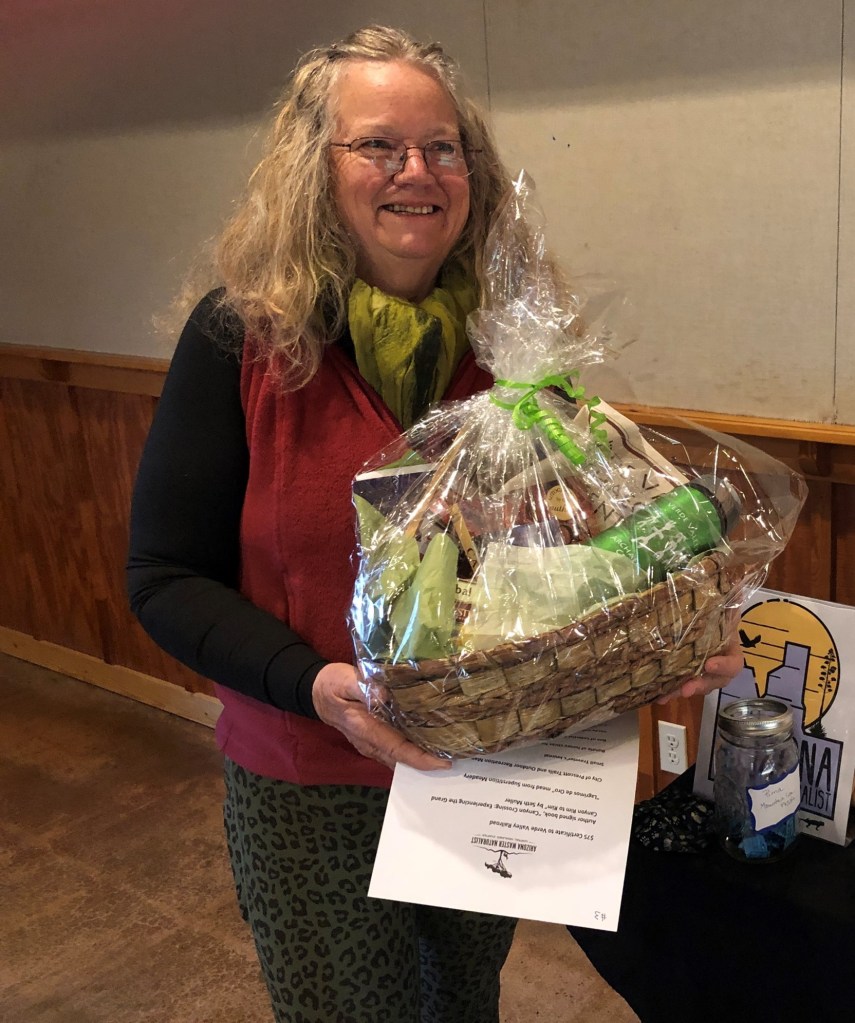
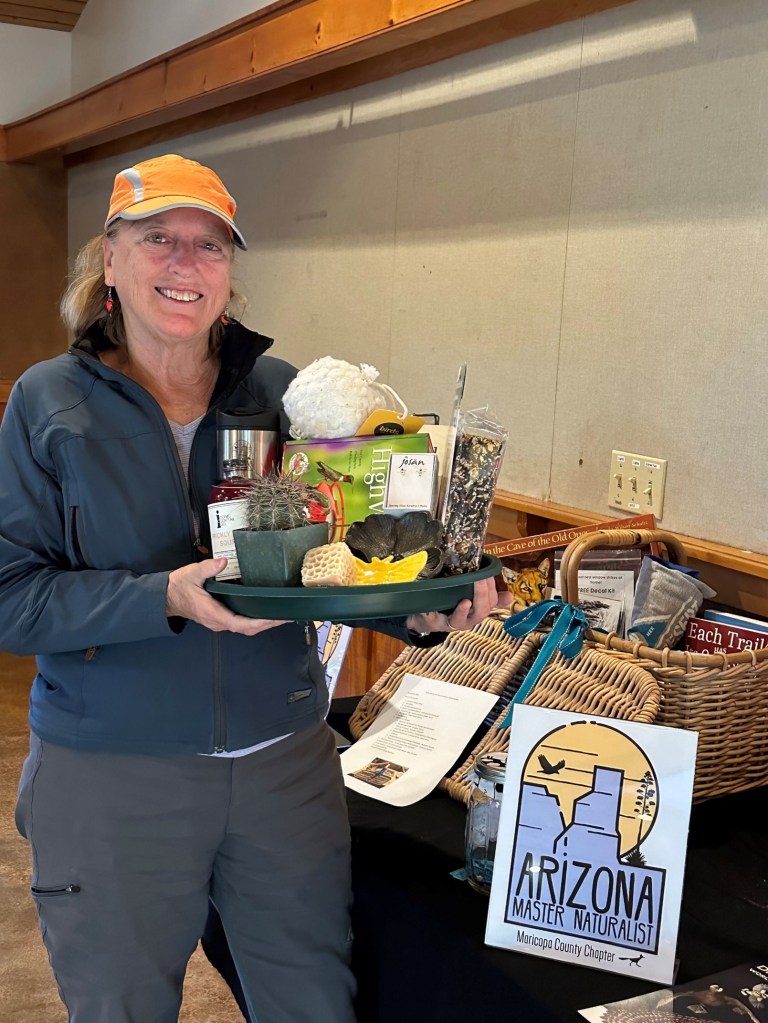
Post from Deb: In addition, the Association held a special raffle whereby each chapter contributed baskets, which included natural and cultural history items related to their area and Arizona. Winners included Dre Hoerr and Peggy Ollerhead from the Pima chapter and Karen Hajek and Darleen Sims from the Maricopa chapter.

Aqua Caliente Park Nature Walk
‘I go to nature to be soothed and healed, and to have my senses put in order.’ — John Burroughs
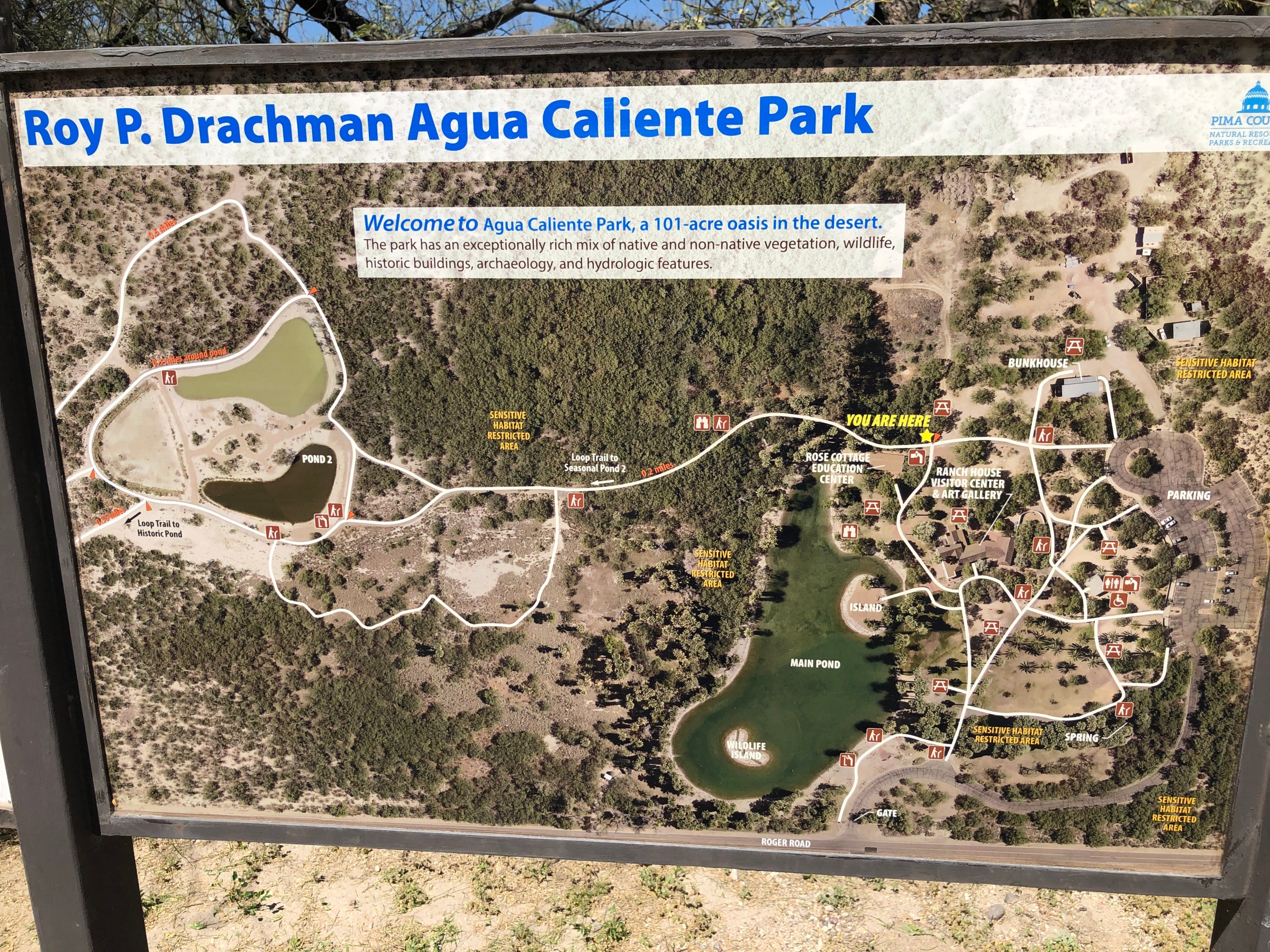
On a beautiful, sunny, 80 degree day at the end of March, I decided to go for a little nature walk and do some nature photography around the ponds and grounds of Roy P. Drachman Aqua Caliente Park (ACP). If you haven’t been, what a local gem this park is, tucked into the Northeast corner of Tucson. ACP is a 101-acre park that was a former working ranch with an orchard, which offers large grass areas, picnic spots with grills and tables, paved walking paths, hiking trails, restrooms, drinking water and reservable spots. The Ranch House has wonderful historical exhibits and furnishings along with an attached gallery presenting various art exhibits throughout the year.
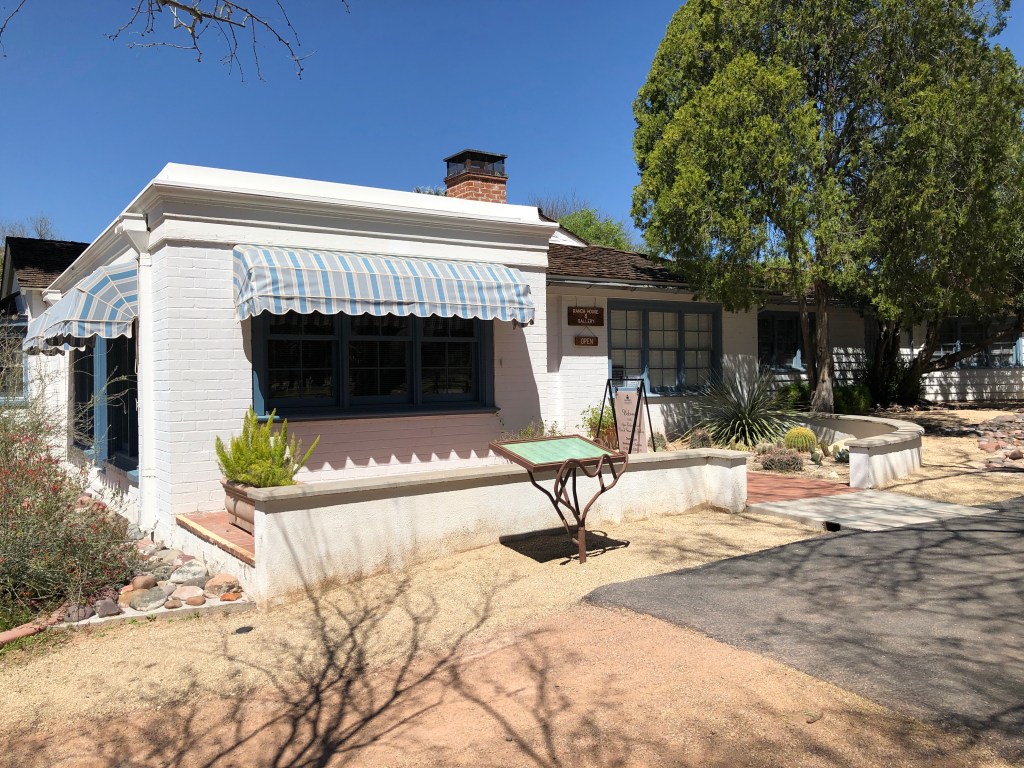
Moreover, what’s so unique about ACP is its perennial warm spring and many California Fan and Date palms that provide vital shelter for western yellow bats, great horned owls, raccoons and other wildlife.


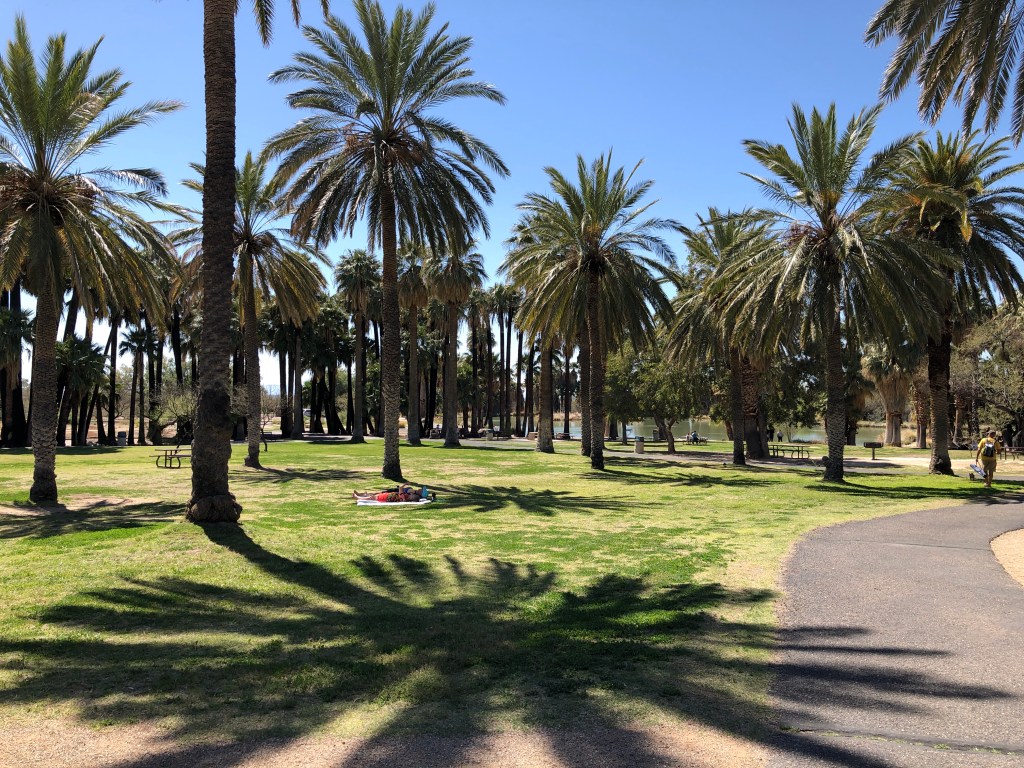
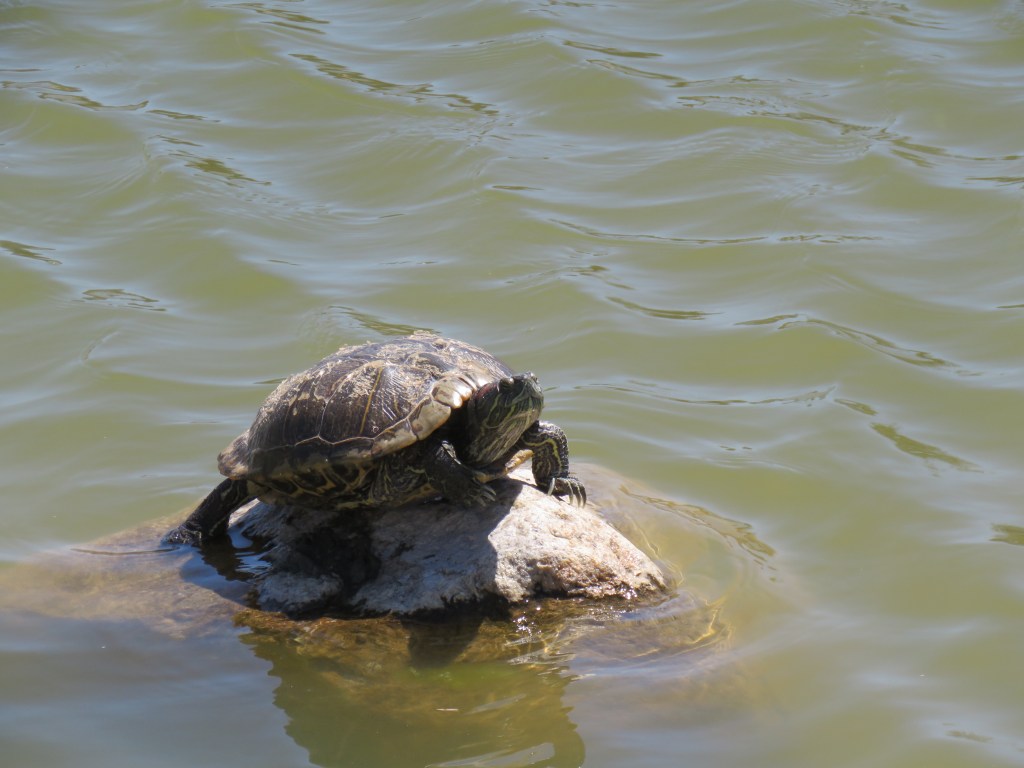
With all of our rains the past few months, 5 ponds were observable with such wildlife as red-eared slider turtles, mallards, great egrets, neotropic cormorants, and ring-necked ducks. Phainopepla, crackles, vermillion flycatchers, Abert’s towhees along with various sparrows and finches were also visible.


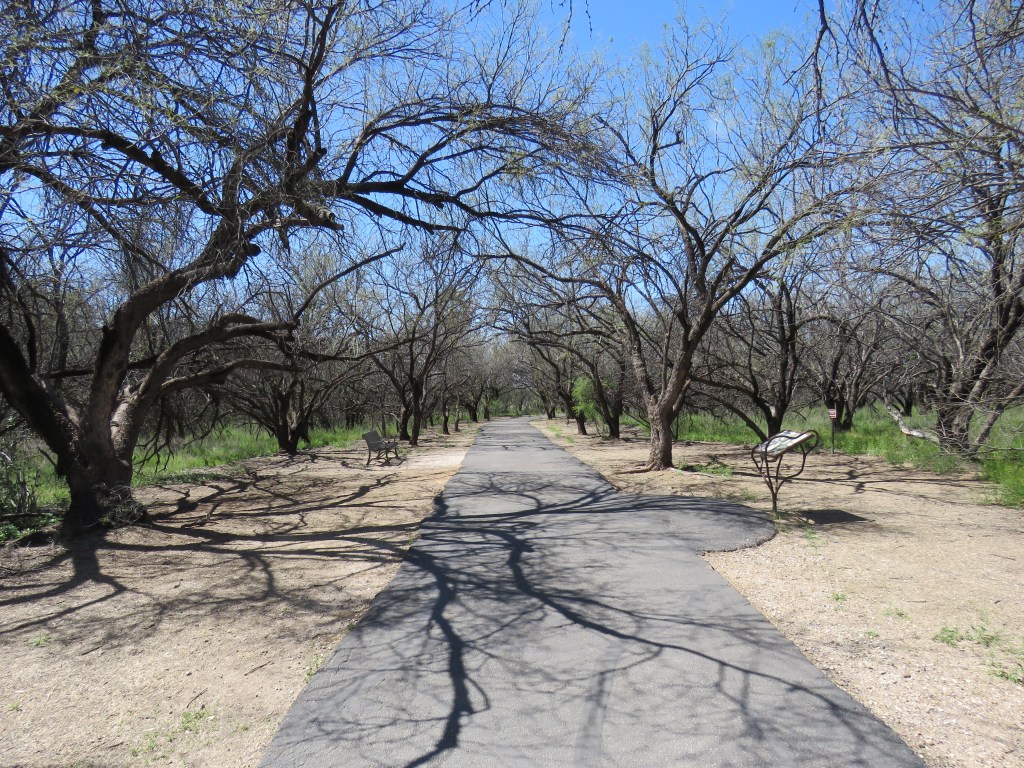

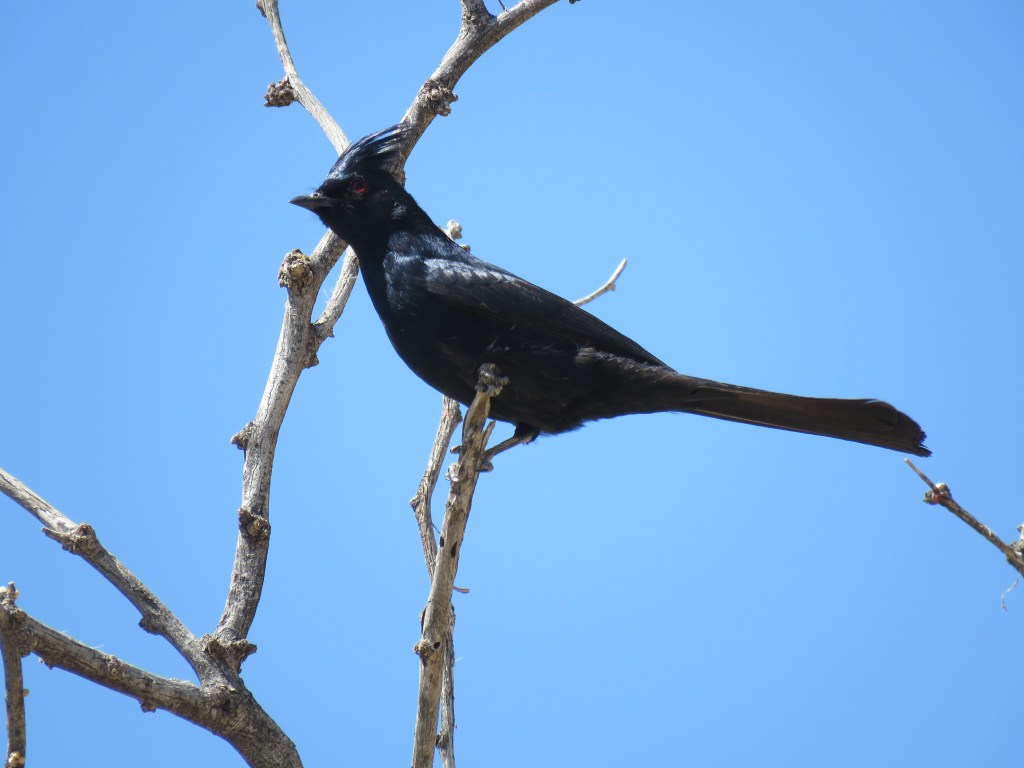
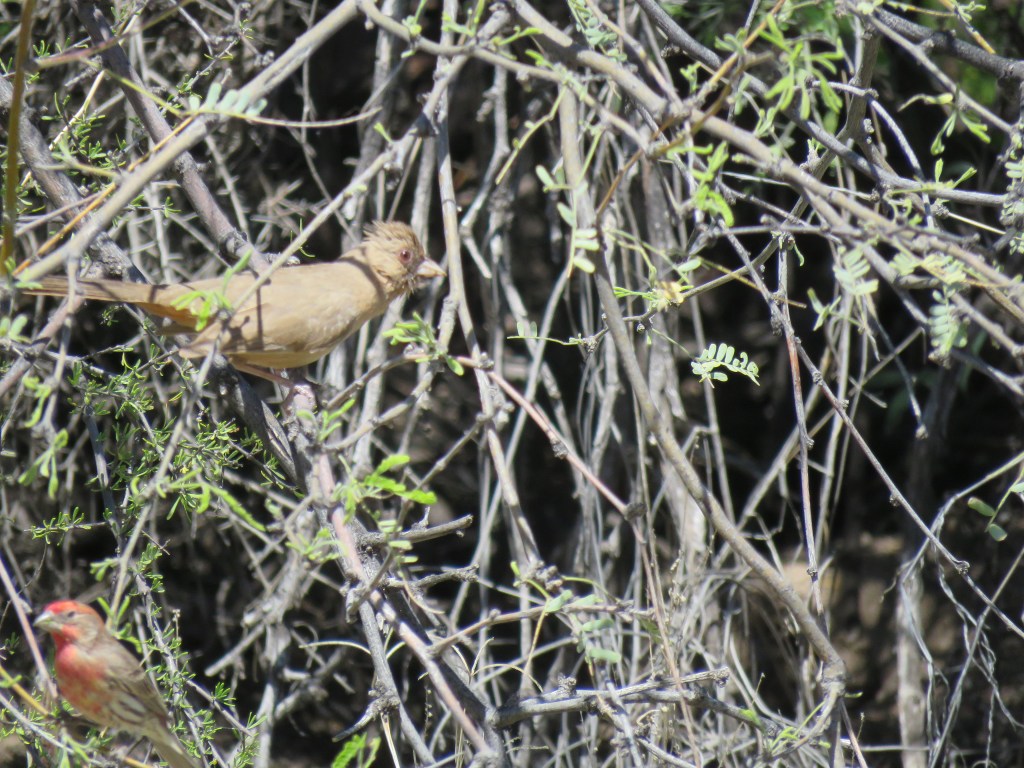

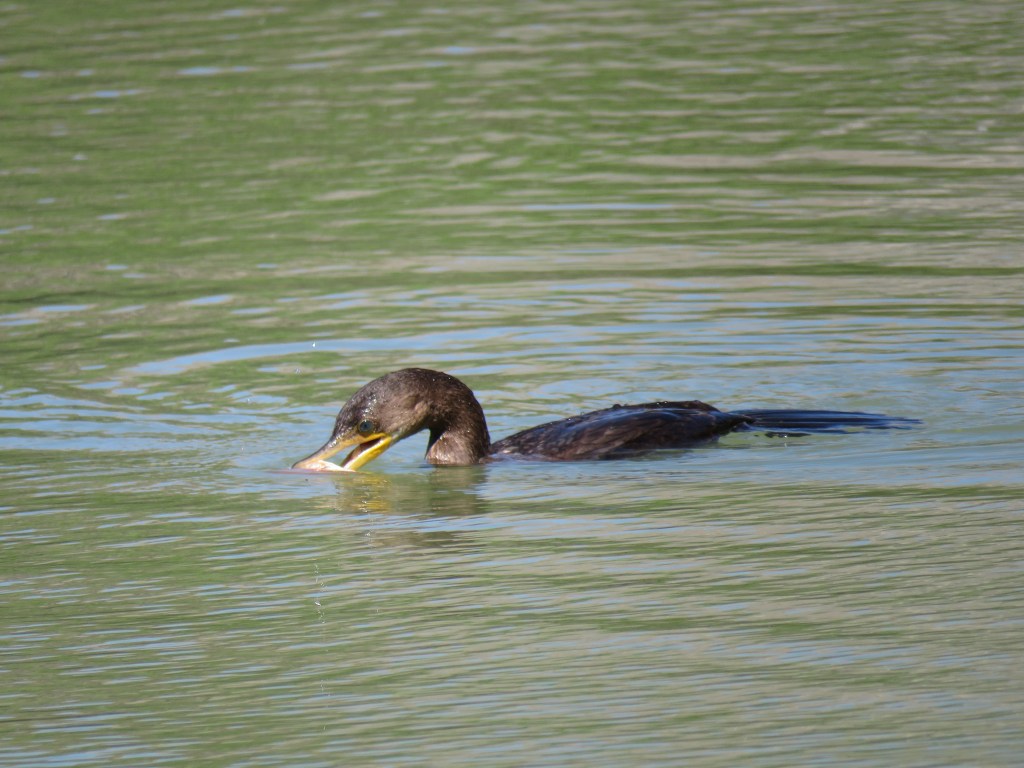
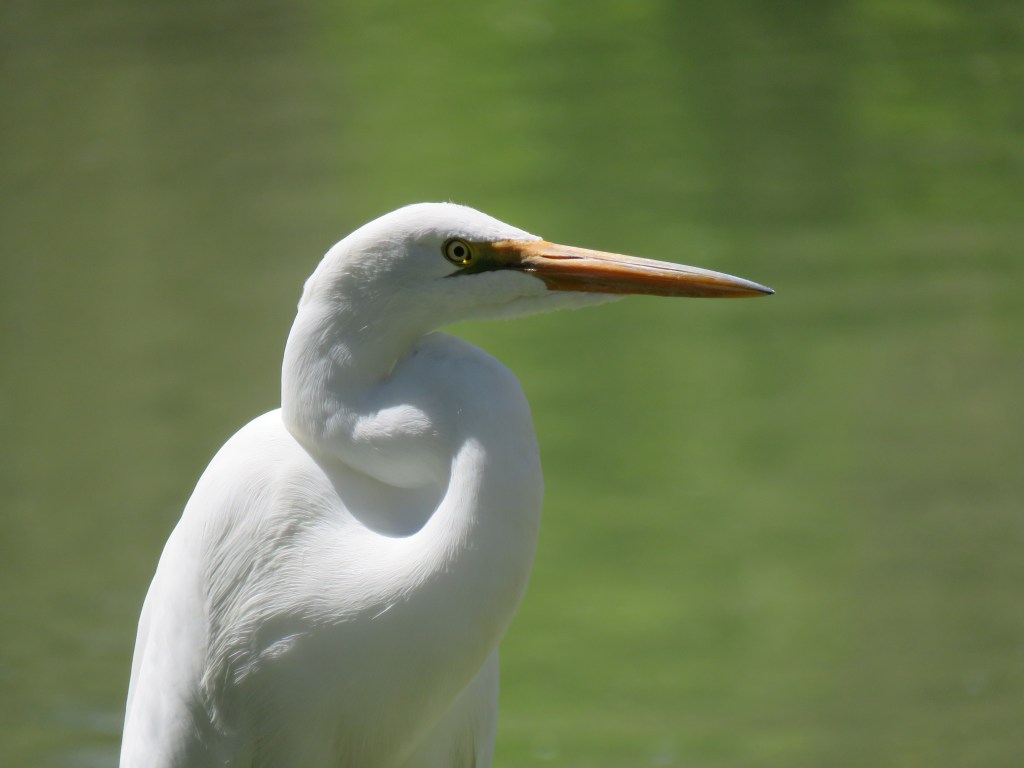
Abundant wildflowers really put on a display including desert chicory, globe mallow, pink fairy-duster, golden marguerite, parry’s beardtongue (penstemon), chuparosa, hairy-seed bahia, and bladderpod, to name a few.

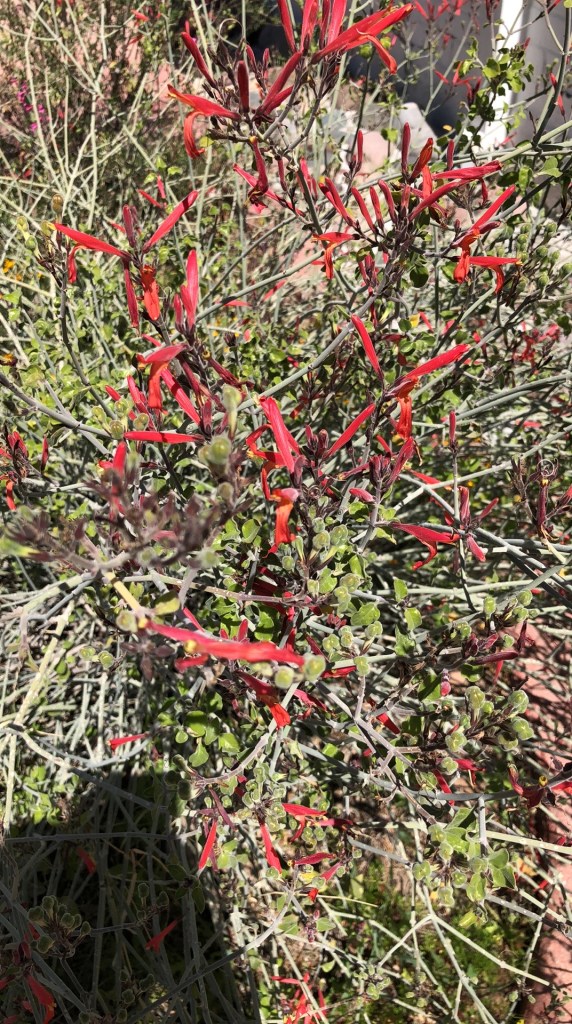

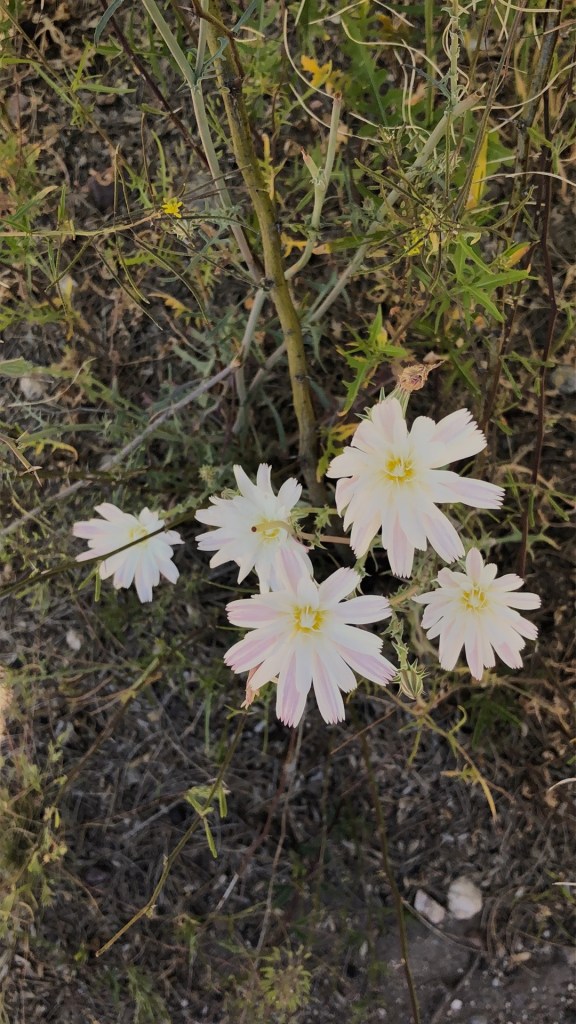
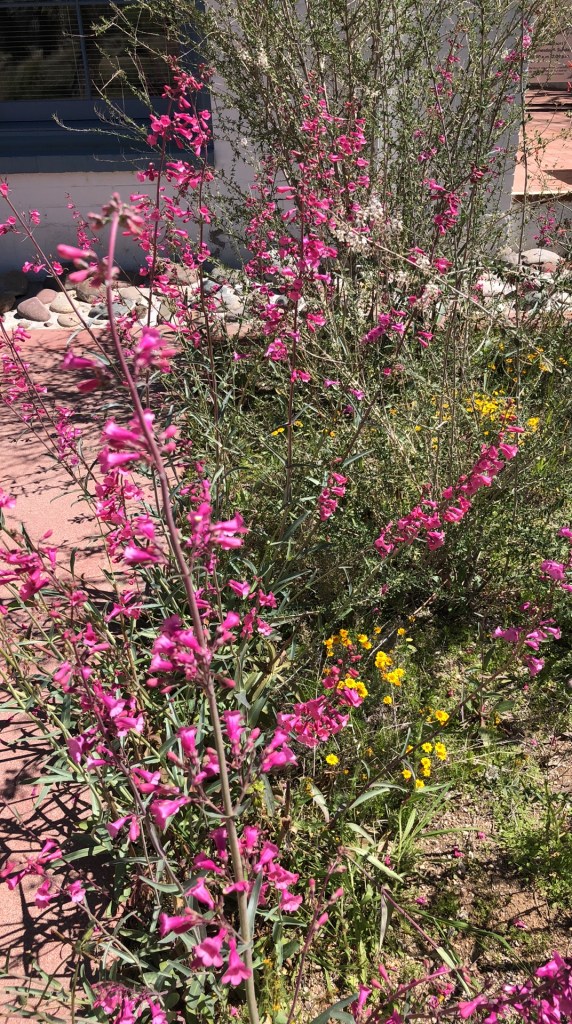

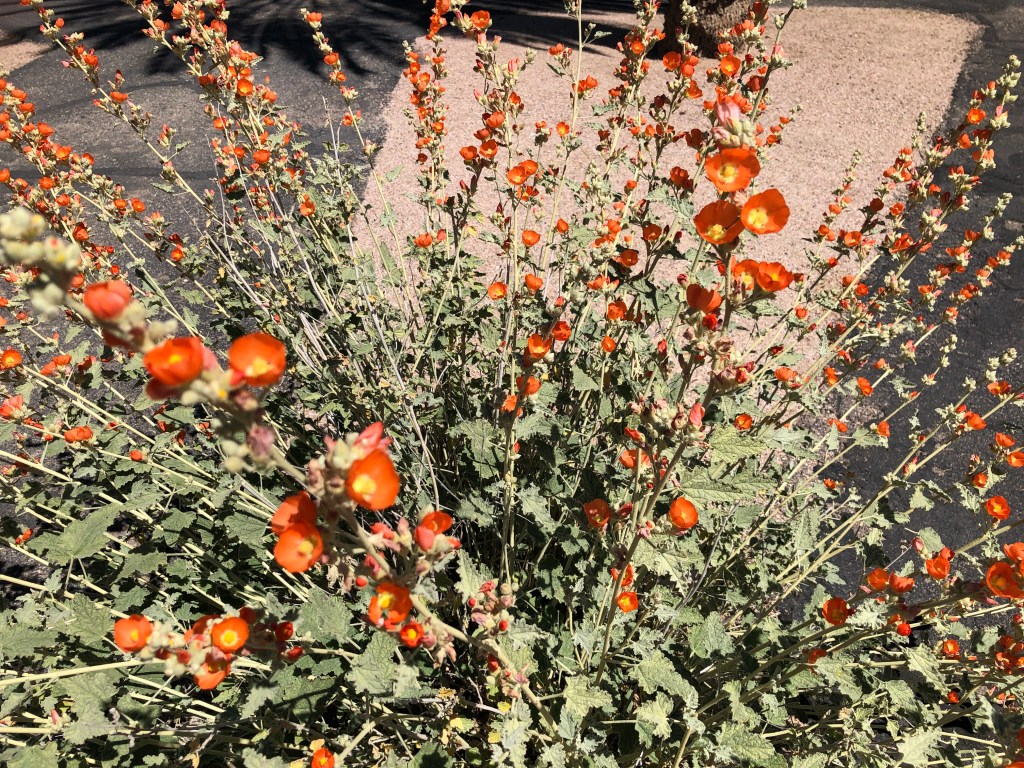
Post and Photos by Deb Petrich, Cohort 1
Naco Arizona
By Franklin Lane, Cohort 1
Just like there are two Nogales’ (ambos Nogales) there is also a Naco, Arizona (pop. ~800) and a Naco, Sonora (pop. ~20,000). Both Nacos are located about (30) miles east of Sierra Vista and maybe (12) miles south of Bisbee, Arizona. There are a couple cool reasons to make this easy day trip from Tucson. The first is to visit the re-habilitation site of Camp Naco and the second to experience the mammoth kill site just northwest of town.
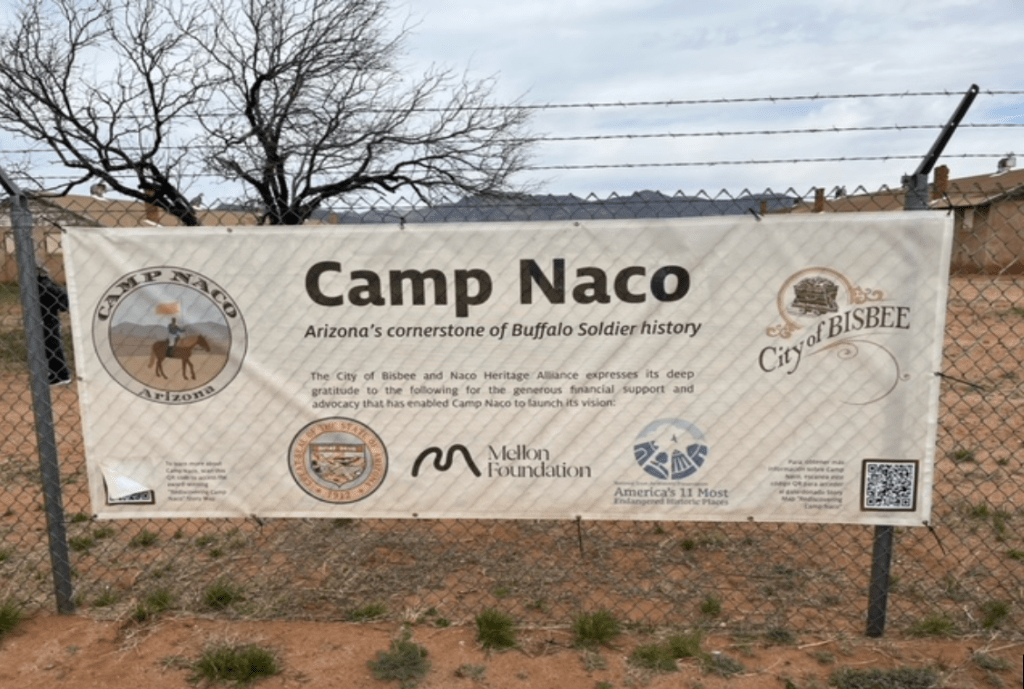
In the words of the Naco Heritage Alliance:
“Camp Naco was established in 1911 in Naco, Arizona as a tent camp manned by the Ninth and Tenth Cavalry of Buffalo Soldiers from Fort Huachuca to keep hostilities from the Mexican Revolution from spilling across the border. In 1919 the US War Department made it a permanent installation. Part of a 1,200-mile chain of military camps along the border from Texas to Arizona. Camp Naco was one of only two constructed of adobe and the only one still standing. The camp was decommissioned in 1923 & repurposed for a Civilian Conservation Corps Camp in the 1930’s. It passed into private ownership in 1960 and is now owned by the City of Bisbee.”
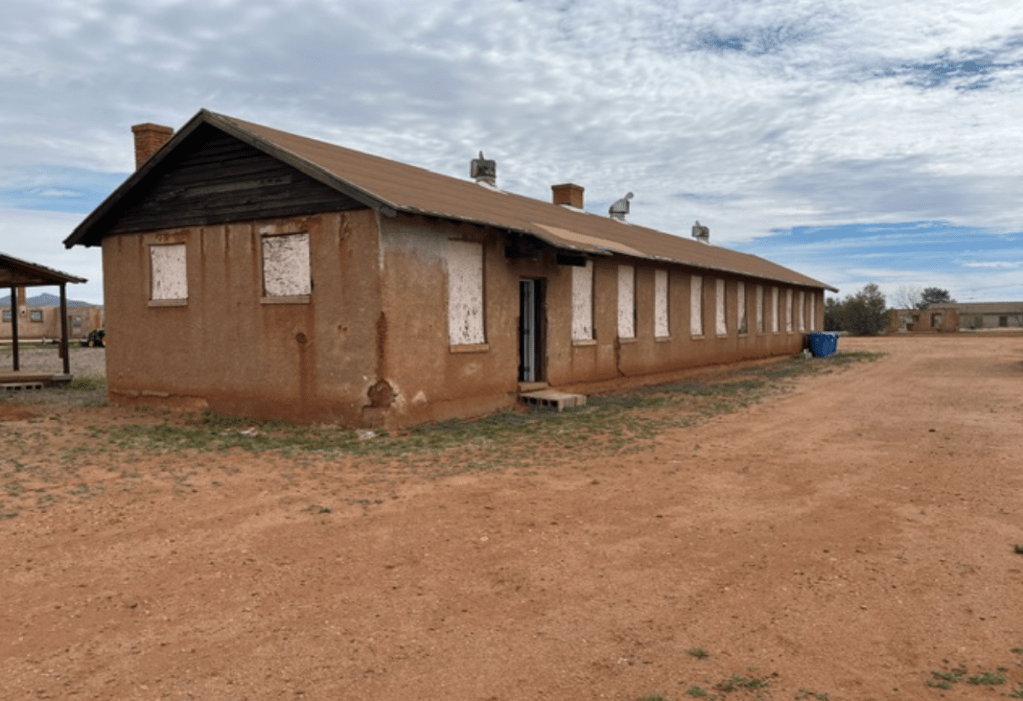
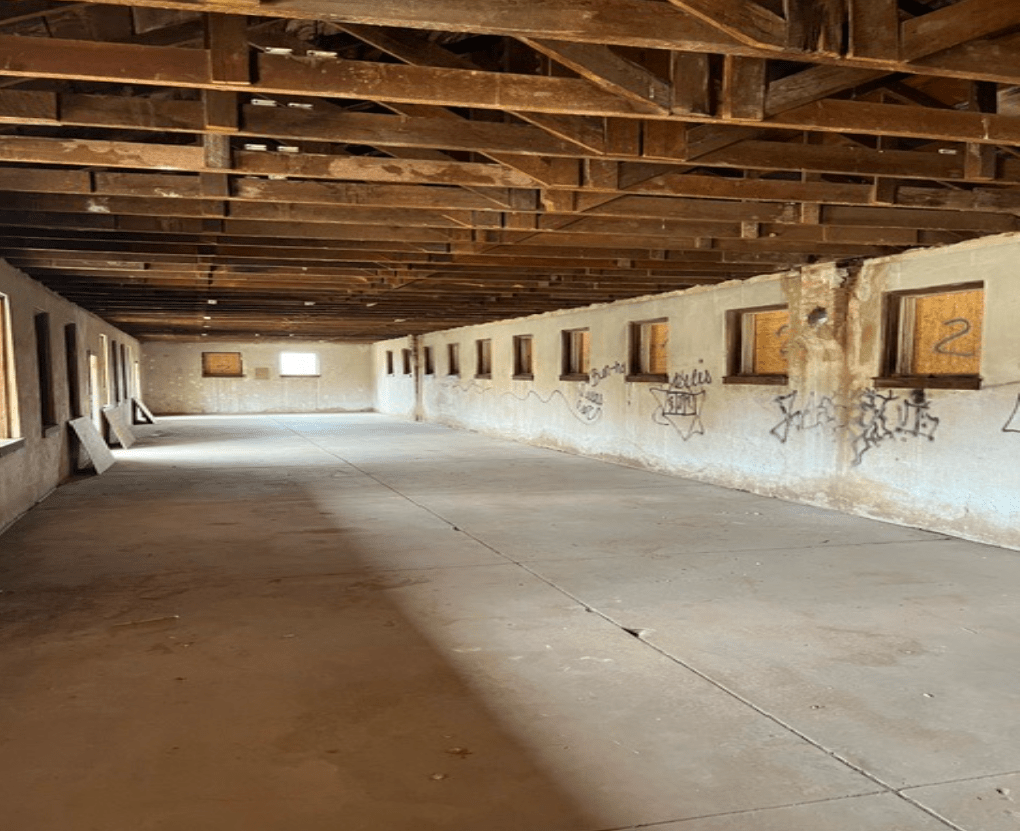
The Naco Heritage Foundation has received several State and Federal grants to rehabilitate the facility into a community center, historical destination and museum. Currently, it is only open to the public during occasional programed events. These events often include participation by the Fort Huachuca Chapter of the Southwest Association of Buffalo Soldiers. Details can be found at: CampNacoAz.org.
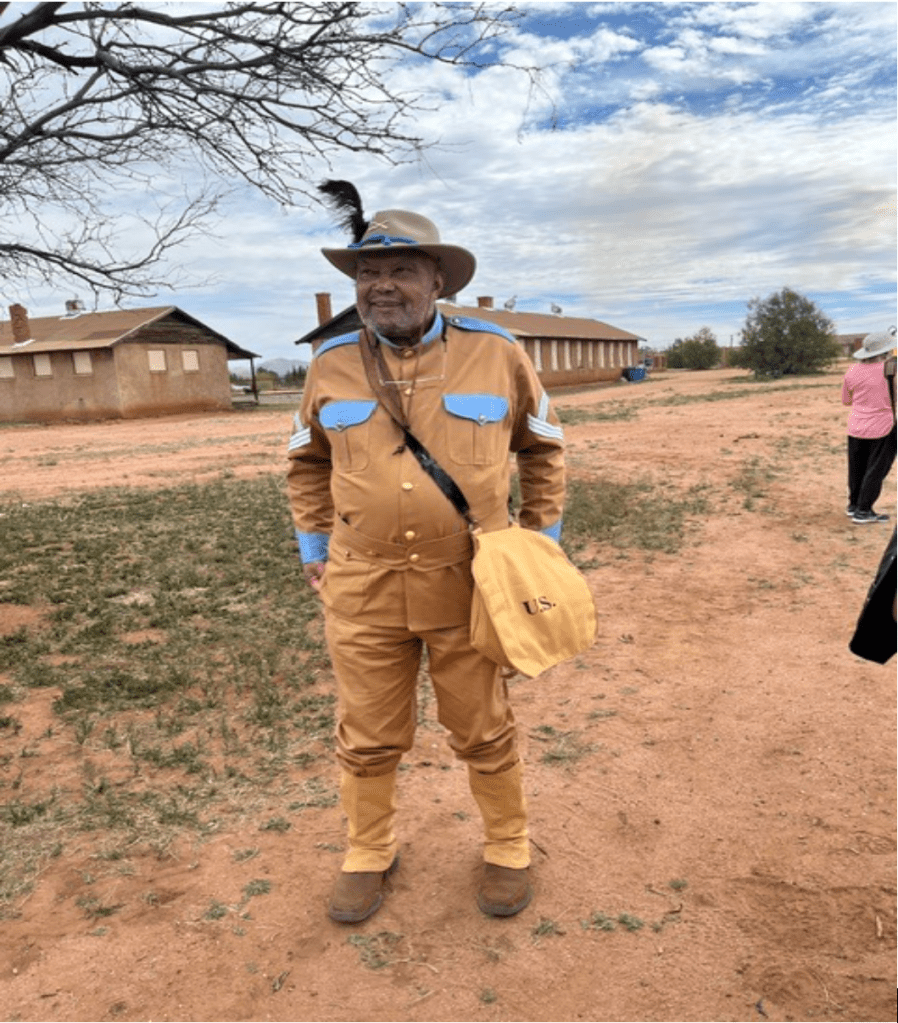
About a mile north of Camp Naco where Greenbush Draw crosses S. Willson Rd. is the Mammoth Kill site first discovered by a local rancher in 1951. The rancher, Marc Navarrete, turned two clovis points over to the University of Arizona. Emil Haury excavated the site in 1952 and uncovered the Colombian Mammoth remains and (6) additional clovis points. The site has been completely scrubbed so casual access is only discouraged by a couple strands of BLM wire. It is a somewhat chilling experience to stand in the site and reflect on the action that occurred ten to twelve thousand years ago.
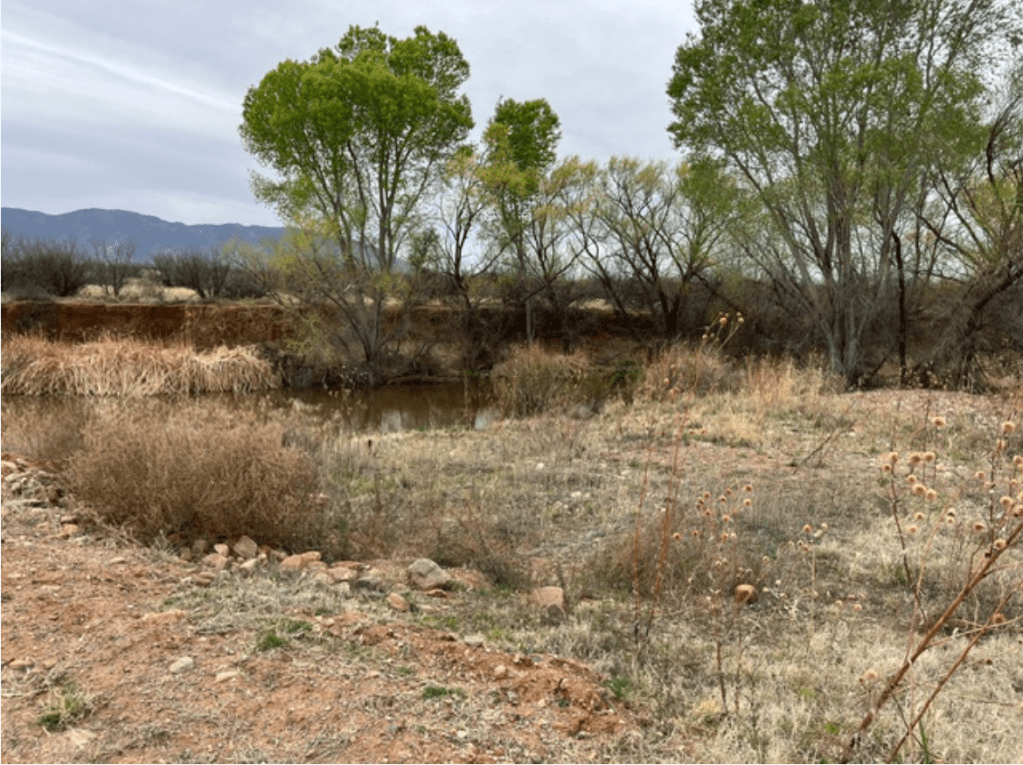
A final interesting stop in Naco is the Gay 90’s Bar. My extensive research has determined that this maybe the closest saloon to the US-Mexico line (maybe 100 feet) of anywhere along the Arizona border. It also serves as a defacto historical museum until Camp Naco is completed. Ask the bartender about Naco’s true claim to fame, as being the only Continental United States city ever bombed by a foreign power. During the Escobar rebellion in 1929 rebel forces hired an Irish-American pilot/mercenary (Patrick Murphy) to bomb Mexican Federal forces in Naco Sonora. Several errant bombs fell on the US side. Aerial bombing was far from an exact science in 1929!

Pima Master Naturalist Presents at Tucson Festival
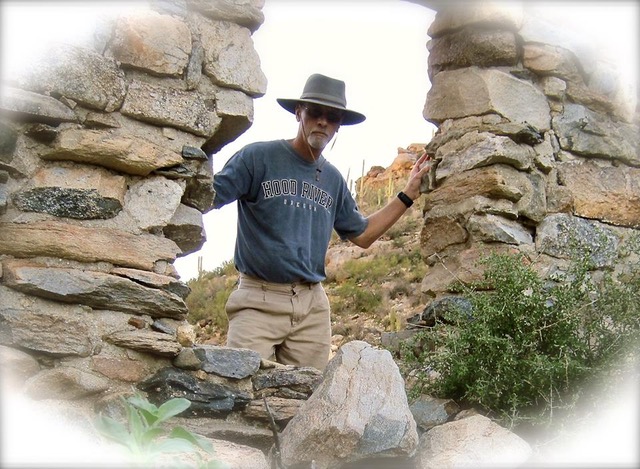
Dan Collins 
Known as “The Tree of Wonders”, the agave has been celebrated in native cultures for centuries throughout the American Southwest and Mexico. That tradition continues today in Tucson’s Agave Heritage Festival, April 17th – 21st, 2024. Established in 2008 as a Cinco de Mayo celebration, the Festival has expanded to include educational seminars, horticultural tours, archaeological excursions, art expositions, music festivals, cultural ceremonies, culinary events, and of course, mezcal and tequila tastings. (festival)
A new program in this year’s festival is produced and narrated by Arizona Master Naturalist Dan Collins; The Amazing Agave presentation is an intriguing overview of “all things agave”. In this enlightening program, we learn how the agave has been utilized by both indigenous and modern peoples to make over 40 products – from textiles to tequila. We also explore today’s commercial enterprises and cultural influences of the agave, uncover the adaptations that enable this native succulent to thrive in the hot and harsh Sonoran Desert, and discover how a prized ornamental holds the promise of a sustainable crop.
Presentations of The Amazing Agave are on Wednesday, April 17th at 10:15 AM and again on Saturday, April 20th at 1:15 PM at Saguaro National Park-West in the Red Hills Visitor Center theater, located at 2700 N. Kinney Road, Tucson, AZ 85743. (map)
 Pima Master Naturalists
You must be logged in to post a comment.