
The Greater Roadrunner Geococcyx californianus
A capstone written by Daniel N. Collins
Arizona Master Naturalist – 2018 Cohort
I froze in my tracks. For any experienced naturalist hiking in the Sonoran Desert, the sound of a rattlesnake elicits that reaction. I carefully surveyed my surroundings…nothing…nothing… nothing…ah…there it was! But it was not the western diamondback I had expected to see on the trail in Arizona’s Tortolita Mountains; instead I was looking at a roadrunner. The loud clacking of its beak – reminiscent of the staccato clatter of castanets – was clearly a warning; perhaps I was was too near its nest. Members of the cuckoo family, both male and female roadrunners produce this clacking sound, as well as a “bark” sounding more like the cluck of a quail. The male roadrunner also makes a dovelike coo to mark its territory and call for a mate. When the roadrunner stopped clacking, I gave the agitated bird wide berth and continued hiking.
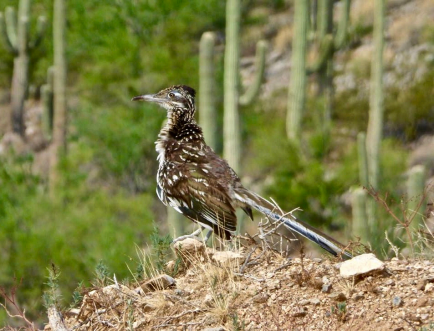
This trail northwest of Tucson is centrally located in the Greater Roadrunner’s range, spanning the American Southwest and northern Mexico. A smaller close cousin, the Lesser Roadrunner or Geococcyx velox, occupies a much smaller range in the southwest regions of Mexico and parts of Central America. It can be found at elevations from sea level to over 6,000 feet and in biomes from grasslands, to foothill woodlands, to chaparral; but it is most readily recognized as a desert dweller, and is undeniably the avian icon of the Mojave, Sonoran and Chihuahuan Deserts. The common element the roadrunner requires in any habitat is large or dense cacti, shrubs or trees. These plants provide shade and lower temperatures during the hotter months, insulation for warmth during the cooler months, protection from predators and nesting sites.
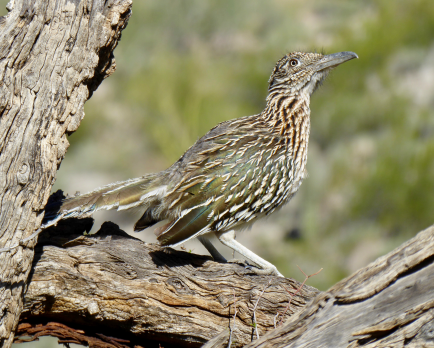
From the tip of its curved beak to the tip of its long tail, the adult roadrunner is nearly 2 feet in length and weighs about 12 ounces. Both sexes are similar in appearance – the male just slightly larger – with a heavily-streaked plumage of white, brown and black, a crest that can be raised or lowered at will, and a post-orbital bare streak behind its eye colored white, slate blue and orange. Its long legs with the cuckoo’s zygodactyl toes (two toes pointing forward and two toes backward) give this bird its distinctive X-shaped tracks, and enable it to reach speeds of over 15 MPH. True to its name, the roadrunner prefers to run, darting and dashing after prey, and flying only a few feet high to gain perch or a few yards to quickly outdistance a predator and seek cover.
The roadrunner is an omnivore, it’s diet consisting of 90% prey – mostly small lizards and snakes. It also consumes small rodents or birds, scorpions and insects. The other 10% of its diet is the fruit and seeds of cacti. This diurnal predator it is most legendary for being a rattlesnake killer. Able to digest rattlers up to 18” long, the roadrunner first approaches the snake cautiously, sizes it up, then attacks. It will use its beak or feet to poke the snake, actually provoking it to strike. If needed, the roadrunner evades the strike by deflecting it with its wings or quickly hopping out of range. But more often it uses its agility, speed and powerful beak to grab the snake’s head mid strike. Once caught, it uses a whiplike motion to beat the snake repeatedly on the ground, causing multiple spinal fractures and death, and making the meal more malleable for digestion.
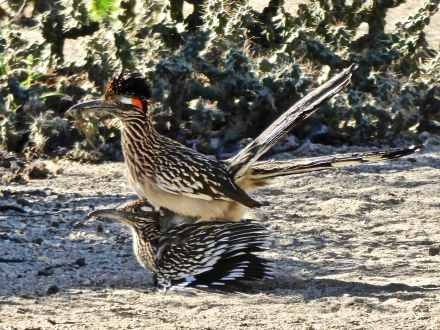
This male roadrunner holds a lizard in his beak, which he will offer to her after mating.
Like many animals, this predator is also a prey for other carnivores. Although a fortunate coyote or bobcat may snag a roadrunner on occasion, roadrunners seldom fall prey to these mammals. The roadrunners’ main threat are raptors, particularly Cooper’s hawks and prairie falcons.
The raptor must catch the roadrunner off-guard however, as numerous anecdotes are told of wary and wily roadrunners taunting hawks, always evading capture, and finally tiring their foe to the point that they actually chase it away from their nests.
If roadrunners avoid predation, they may live to be six or seven years old, and produce several offspring during their life. The male roadrunner approaches a female in the spring of the year with a twig in his mouth, a not-so-subtle invitation to building a nest together. Before she approves of him as a lifelong mate, she will put him through many courtship rituals. All of these are to test his prowess as both a provider and protector. His final approach is with a vertebrate offering, such as a small lizard or snake. If she assents he will mount her – the tasty treat still hanging from his beak – which he will reward her with once copulation is complete.
A second breeding season may occur in fall, depending on abundant summer rains and resulting ample prey. In wet years two, three or even four clutches of eggs may be produced. In dry years, no breeding may take place. Each clutch produces three to six eggs which are laid in a nest typically located low in the thicket of a paloverde or mesquite trees or cholla cactus. Only half of the hatchlings will survive to maturity; the remainder fall victim to starvation or predation.
Both sexes take turns incubating the nest, though he is responsible for the night shift, as she must conserve her energy. Like all roadrunners not nesting, her body temperature drops dramatically at night, from 103℉ to 93℉. As she sleeps her metabolism will slow and her body cools, reducing her caloric need some 40% over her mate. In the morning she will reverse the process, turning her back to the sun, lowering her tail and spreading her wings. She erects the feathers on her back, exposing a patch of black skin that heats her body through solar radiation. Her high daytime body temperature is an adaptation to better cope with the ambient desert heat.
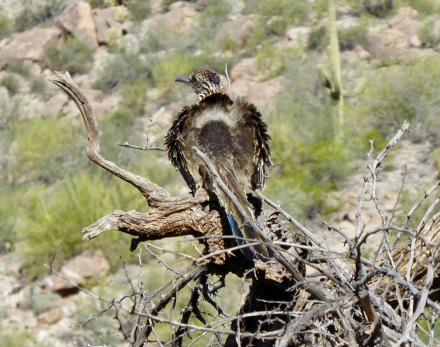
A female roadrunner exposes the black “solar panel” on her back used to warm her body.
With its amazing adaptations, amusing antics and abilities as a hunter, the roadrunner has earned the respect of all cultures, both ancient and modern. The Chemehuevi tribe of the Mojave Desert derive their name from this bird; the story is told when tribal leaders first saw the Chemehuevi Valley full of mesquite beans, they raced down to it with their “nose in the air like a roadrunner”. Cowboys told tales how the roadrunner would seek out sleeping rattlers, then build a corral of cholla cactus joints around them to entrap the hapless reptiles. Warner Brothers Studios Roadrunner cartoon has remained popular since its 1949 inception. Whether in fact, folklore or film, this icon of Northern American deserts has earned its legendary status.
RESOURCES
BOOKS:
Cornett, James W. The Roadrunner. Palm Springs, CA: Nature Trails Press, 2001
Kauffman, Kenn A Natural History of the Sonoran Desert, pp. 350-352. Tucson, AZ: Arizona Sonora Desert Museum Press, 2015
Taylor, Richard Cachor Birds of Southeastern Arizona, pp. 158-159. Olympia, WA: R.W. Morse Company, 2010
Tweet, Susan J. The Great Southwest Nature Factbook, pp. 72-73. Bothell, WA: Alaska Northwest Books, 1992
WEBSITE:
The Cornell Lab of Ornithology – All About Birds: Greater Roadrunner http://www.allaboutbirds.org
PHOTO CREDIT:
All photos © 2018 by Daniel N. Collins
How to Use Naturalist Skills to Enhance your art
Artists have always been inspired by nature. We love to capture or create images of our favorite landscapes, animals, moments, and scenes. But well-practiced artists will tell you that nature can be more than just a muse. I have learned about the benefits of using skills taught to me as a naturalist to enhance my artwork. Nature observation and study skills are incredibly useful to any painter, illustrator, sculptor, or photographer.

I was recently asked to create a set of designs for enamel pins for the Arizona Master Naturalist Association. I have a moderate amount of experience with digital art, but this would be my first time attempting pin design. Pins require a unique art style because they have to use limited colors and have thick lines to accommodate the pin printing process and they need to get their point across in a very small space. I was faced with the challenge of creating art of something as complex as a California condor or ponderosa pine on a “canvas” about the size of a quarter.
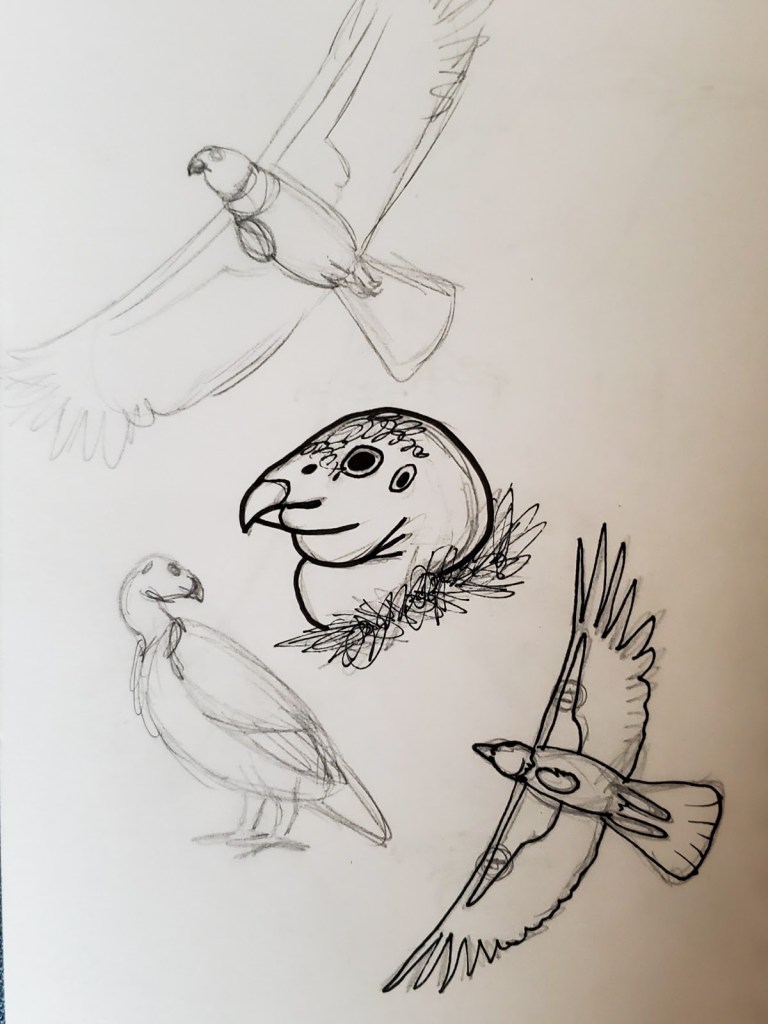
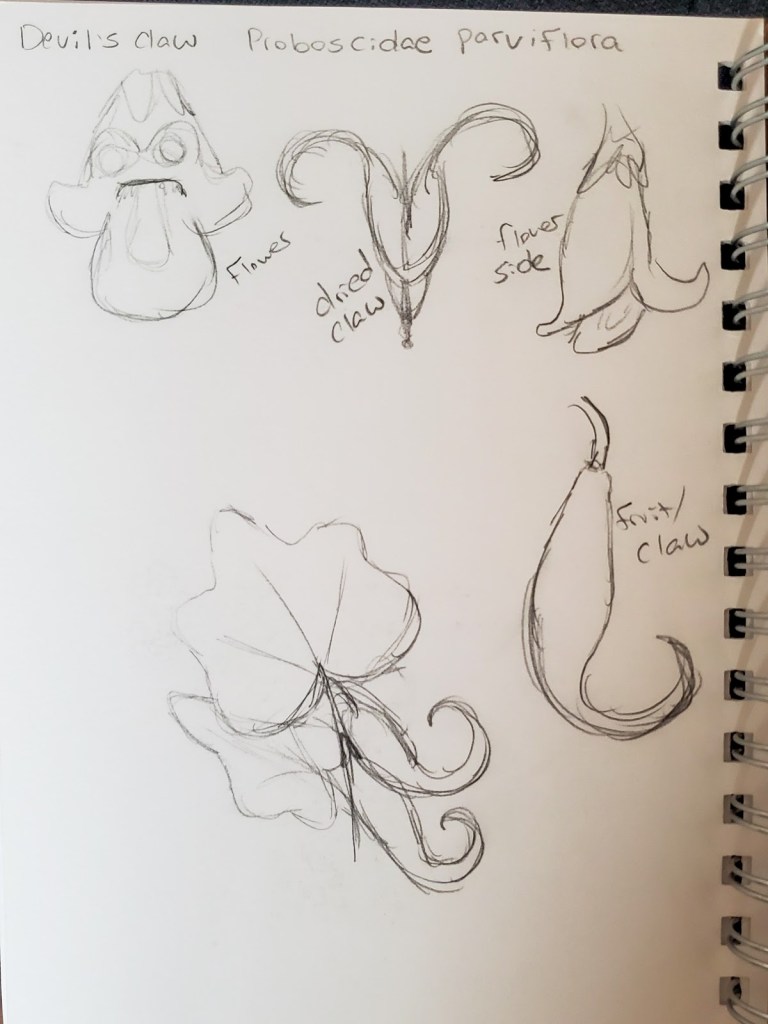
Like many artists I started by looking at reference pictures of my assigned flora and fauna. This is where I began to use my naturalist skill of observation. During one of my winter field labs with the Pima County chapter of the Arizona Master Naturalists, we learned about nature journaling. We learned to look at an object, say a small plant, and try to draw it. This exercise seems easy enough if you sketch some abstract leaves in a few seconds — but will one of your classmates be able to guess what plant you drew if they see your drawing? This is where it helps to look — to really look — at your subject. In class we learned to look at the margins of the leaves, texture of the bark or stems, colors, veins, spines, thorns, shape, texture, and so much more. I then used these newly-learned observation skills with the pin designs. I observed how condors actually hold their wings when flying and how pine tree’s branches actually hang. The more I practiced focusing on all the details of my subject the better I became at recreating them in a way that others can also observe and understand.
The next naturalist skill I learned to employ in my art is interpretation. As naturalists we learn how to take the knowledge that we have and interpret it for a variety of audiences. How we present information on pollination to a group of master gardeners should be different than how we present it to fourth graders. This idea holds true for art. How I might draw a pine tree for a large mural is different from what I needed to accomplish for a pin.

Using these skills I began to create sketches of my subjects. I asked myself questions about what angle, scale, and even phenophase I should use. Should I interpret a bushy plant by drawing one entire bush, a clump of its leaves, or just a single flower? Should I interpret a bird perched calmly or soaring high above?
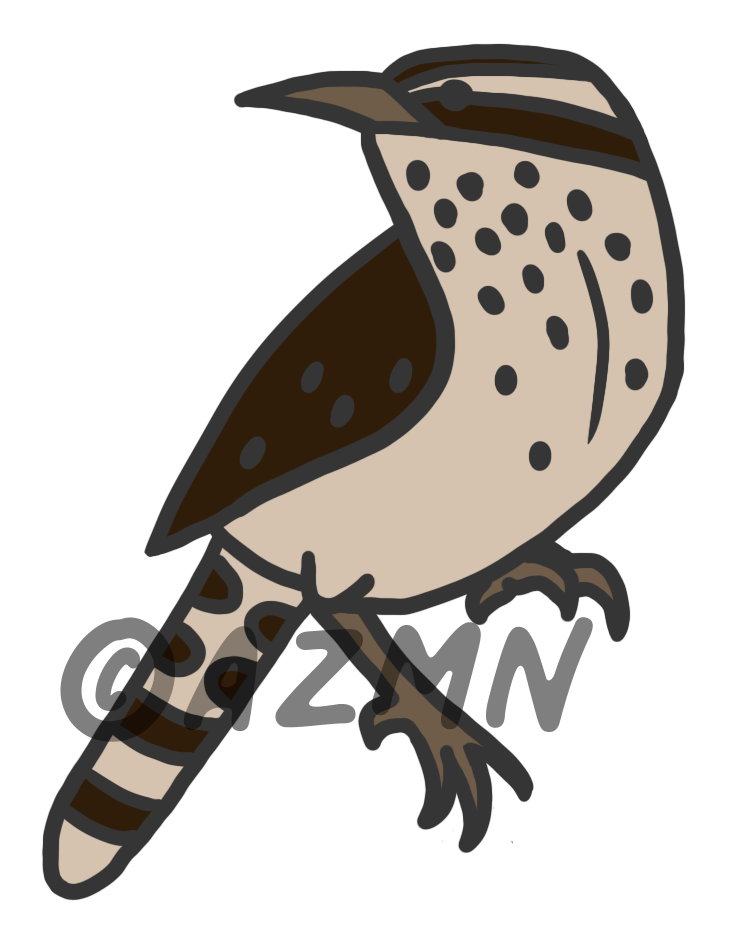
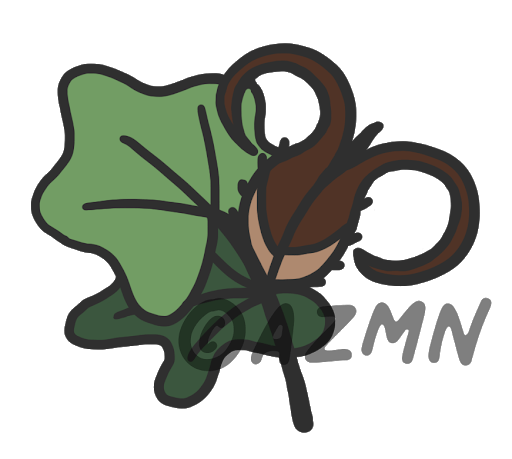
These four images are examples of the final designs I created for this project. Each subject was carefully observed, interpreted, and designed to best identify the species to any viewer. I chose two plant designs and two bird designs to share with you to demonstrate how I tackled similar organisms so differently. The skills I have learned as a naturalist are what allowed me to create these designs in this style, and I hope that you can also find ways to incorporate your skills into any art you create!
Climate Change statement by PCMN

November 9, 2020
WHY WE, AS MASTER NATURALISTS, SUPPORT CLIMATE CHANGE ACTION
“Now is the time for science, not silence” (Scientific American, 10/8/2020).
Daily Global headlines and increasingly frequent observations of extreme weather events demonstrate that the science of climate change is all around us. The recent excessive heat and drought of our own Sonoran Desert provide abundant local evidence, as Tucson recorded both its hottest month and hottest year on record in 2020. As far back as 2011, the City of Tucson’s Climate Mitigation Report identified climate change as a threat to Tucson’s public health and safety, naming such hazards as wildfires, drought, flooding and extreme heat. As in other beleaguered cities, marginalized populations are most affected by climate change, and are most at risk.
On September 9, 2020, the City of Tucson declared a Climate Emergency, stating, “…a climate and ecological emergency threatens our city, region, state, nation, civilization, humanity and the natural world, and [we] recognize the need for bold action to combat climate change, so that it meets or exceeds the current recommendations of the foremost climate scientists working around the world.”(Resolution No. 23222,2020).
We, as the Pima County Chapter of the Arizona Master Naturalists, acknowledge that climate change is real, and we align with the scientific consensus that human activities are the main cause. We support the City of Tucson’s Climate Emergency Declaration and vow to support climate change action in our communities. Master Naturalists are a corps of trained and skilled volunteers who provide leadership in education, citizen science, and stewardship to all natural and cultural history organizations in Arizona, for the public good. We actively engage with our community in helping to create a sustainable world.
We are not isolated in our work; we understand the inter-connectedness of all life on Earth. As such, we support efforts here and elsewhere to address the serious issue of climate change, and we call upon our community and national leaders to strengthen their efforts and commitments to this crucial endeavor. Tucson’s recent Climate Emergency declaration acknowledged it clearly, “the United States of America has disproportionately contributed to the climate and ecological emergencies and thus bears an extraordinary responsibility to rapidly resolve these crises”.(Resolution No. 23222, 2020). We pledge to use our skills to further educate our community, to engage in the direct observations necessary for collecting citizen science data, to continue our stewardship and protection of the natural world, and to ensure that local climate change action is just and equitable. We urge you to join us and learn how you, too, can actively participate in addressing climate change.
Franklin Lane
President
Pima County Chapter
Arizona Master Naturalists
Leaving the Huachucas
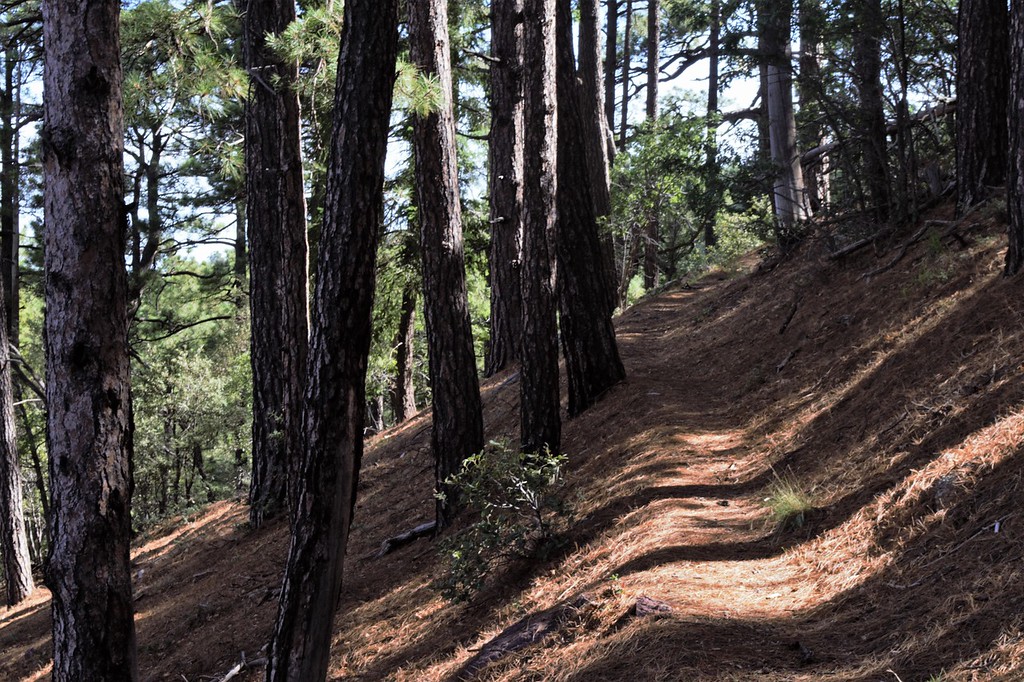
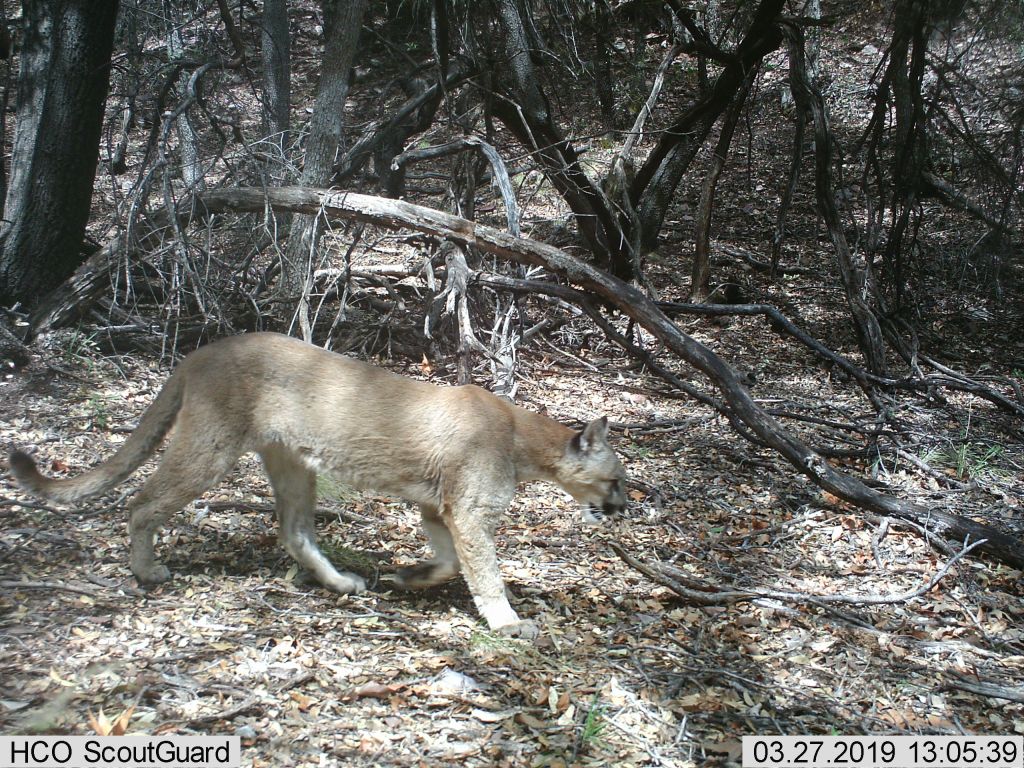
On Saturday 11/14/2020 my trail partner, and fellow Master Naturalist, Deb Huie (C1) and I pulled our UofA/USGS trail cameras from the Huachuca Mountains. We’d been monitoring these sites for spotted cat activity (Jaguar and ocelot) since late 2016. Deb called it a “bittersweet day” because although it is a very tough 4 wheel drive approach and even harder hike we had grown to love this beautiful, remote area under all sorts of weather and conditions. But we also knew it was time for a new adventure. We’ll continue our Citizen Science work in the Whetstones.
While the Huachuca’s are excellent habitat for both cats we hadn’t had a detection on either of our sites since March 2017. The attached photos are of that individual male and, unfortunately, that of his eventual poaching when he returned to Northern Mexico. The rosettes on a jaguar’s coat are like fingerprints so individuals can even be recognized with a good photograph. This loss was heart breaking for us but also made us all the more determined to do everything we can to expand and protect their habitat in the U.S.

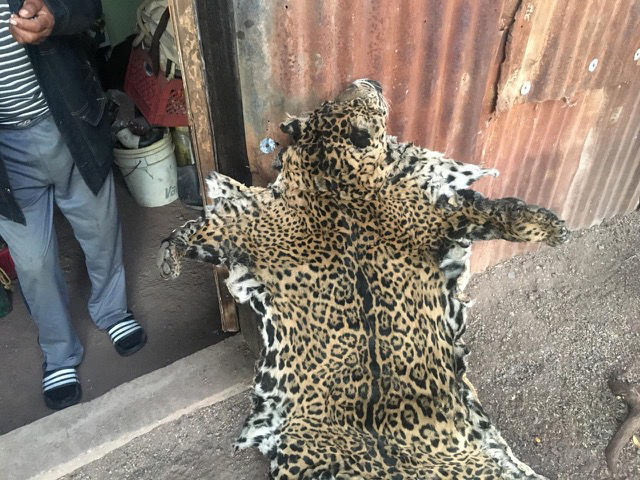
The Project (Directed by Dr. Melanie Culver) has cameras in all the major mountain ranges along La Frontera (The Borderlands) from the Baboquivaris to the Peloncillos. Many of the sites are remote but there are also some closer to Jeep roads and the Arizona Trail. We are always looking for dedicated volunteers. Film (SD cards) needs to be retrieved and batteries replaced (3-4) times a year.
Garden Canyon on Fort Huachuca is where we accessed our sites. One site was actually within Fort boundaries and the other was out a wilderness gate into the Coronado National Forest. The site on the Fort was complicated because…. well its the U.S. Army. Garden Canyon is a little known, but beautiful, recreation area that has tremendous hiking, birding and even pictographs. The area is open to the public on the weekends and during the week if there is no “live fire” on the Fort’s shooting ranges. Unless you have military privileges you’ll have to obtain a day pass at the Fort Huachuca Main Gate. But it’s easy to do! There are also some great museums on the Fort including one dedicated to the Buffalo Soldiers. Unfortunately no camping unless you hike past the Fort’s wilderness boundaries.
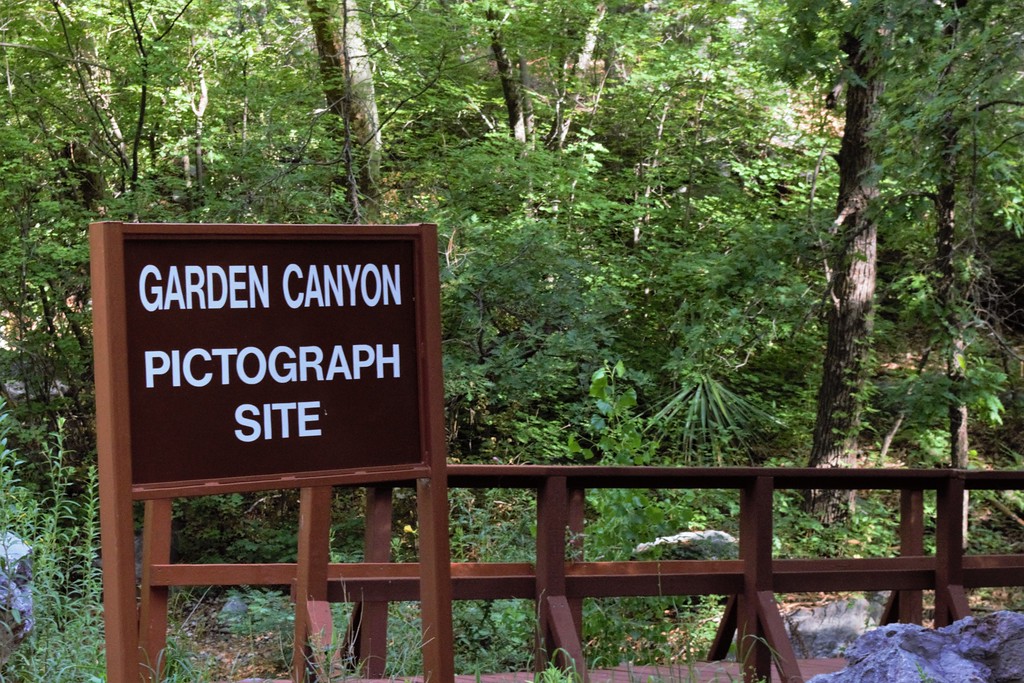
With one of our old sites above 8600 feet, we sometimes had to contend with some challenging conditions. Here’s Deb in February 2020 post-holing her way up above 8,000 ft.

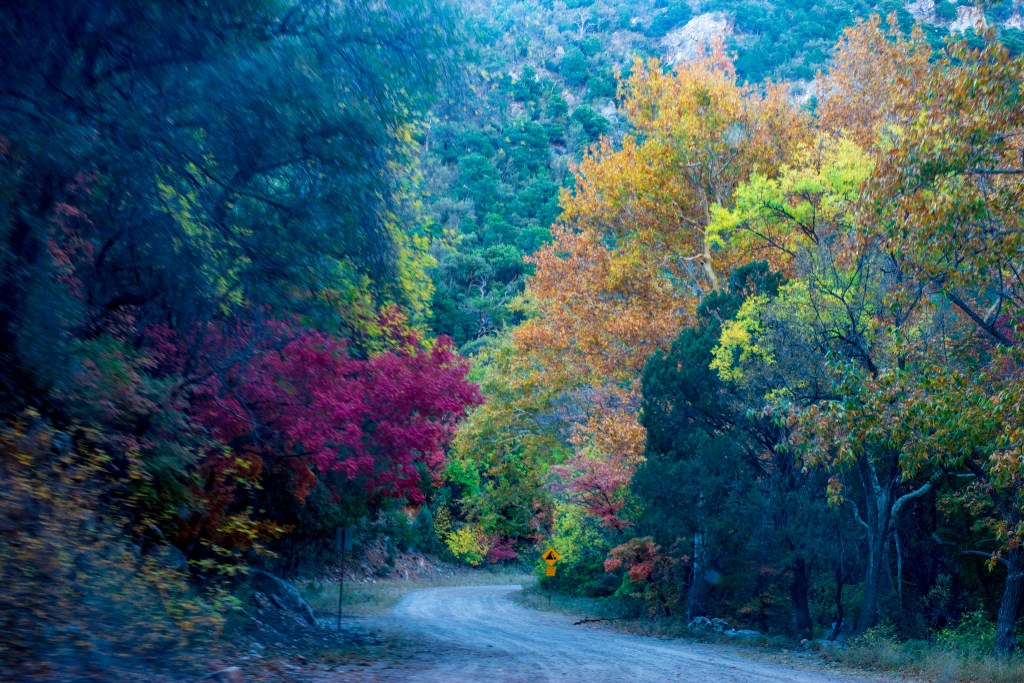
This past Saturday was gorgeous although we probably missed ideal Fall foliage by about two weeks. Here are some of Deb’s pictures over the last couple of years.
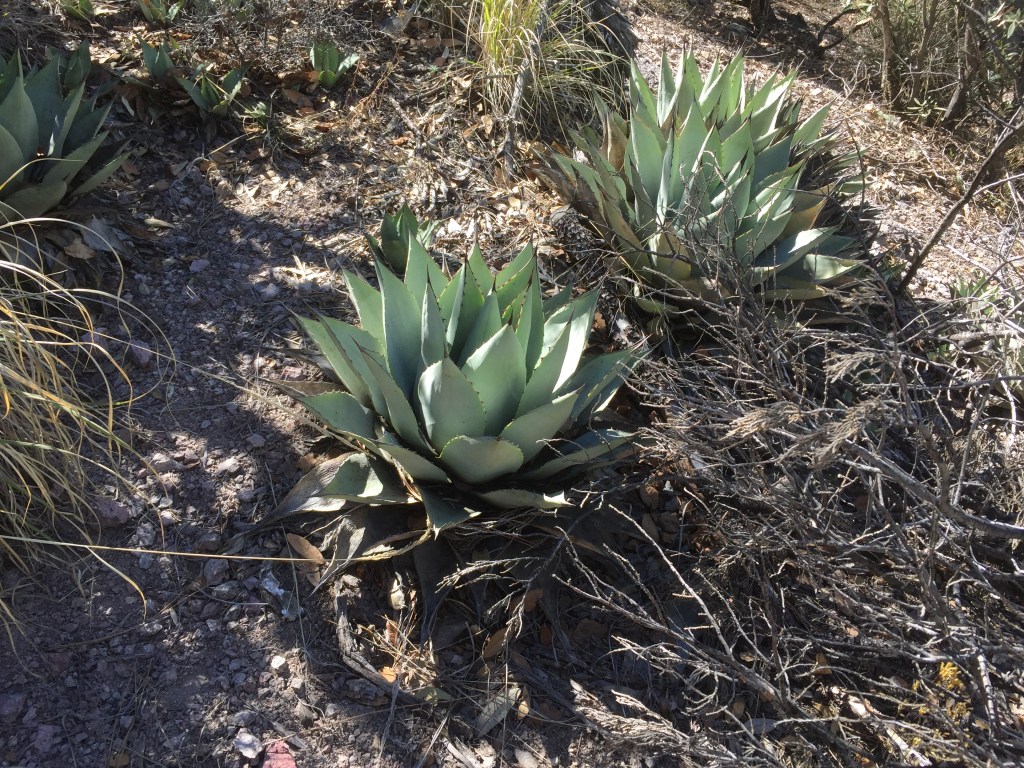


Finally here are some examples of the abundance of wildlife on this incredible Sky Island.
“There are some who can live without wild things, and some who cannot” Aldo Leopold


If you are interested in participating in the project contact me personally or through the email of the President of the Pima County Chapter, Arizona Master Naturalists.
Franklin Lane
Communing with Nature: Madera Canyon
Submitted by Kathy Mclin, October 2020
In these past months, Communing With Nature has become as much necessity as passion. And, when I’ve trekked about it’s been great having a like minded friend to share with, each experience.
On a warm day in late September, my friend Suzanne and I decided to head to Madera Canyon. A popular birding spot, endorsed by Tucson Audubon’s Volunteer and Festival Coordinator, Luke Safford, for its wide variety of native and migratory birds.
We were barely headed up the road to the Carrie Nation Trailhead when we stopped to photograph and document a Gould’s Tom Turkey and two of his hens. Iridescent in the sunlight Gould’s are one of two turkeys native to Arizona, Merriam’s the other.
Arriving at our destination we began a gradual climb up Carrie Nation keeping our eyes and ears focused on the sights and sounds around us. Hiking with a simpatico other(s) is an essential for optimizing each adventure. We stop often, look for scat, flora, movement, unusual looking objects and listen. For us, It’s not a race, but an experience, filled with suspense, grace and new discoveries.
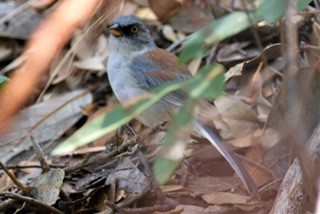
The birds were elusive as we climbed steadily upwards. Acorn woodpeckers, and Mexican Jay’s, teased us by perching behind tangles of branches. Only the Bridled Titmouse and a few Yellow eyed Junco’s were willing to share open space with us. Turkey Vultures dotted the sky above.
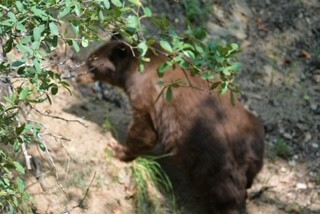
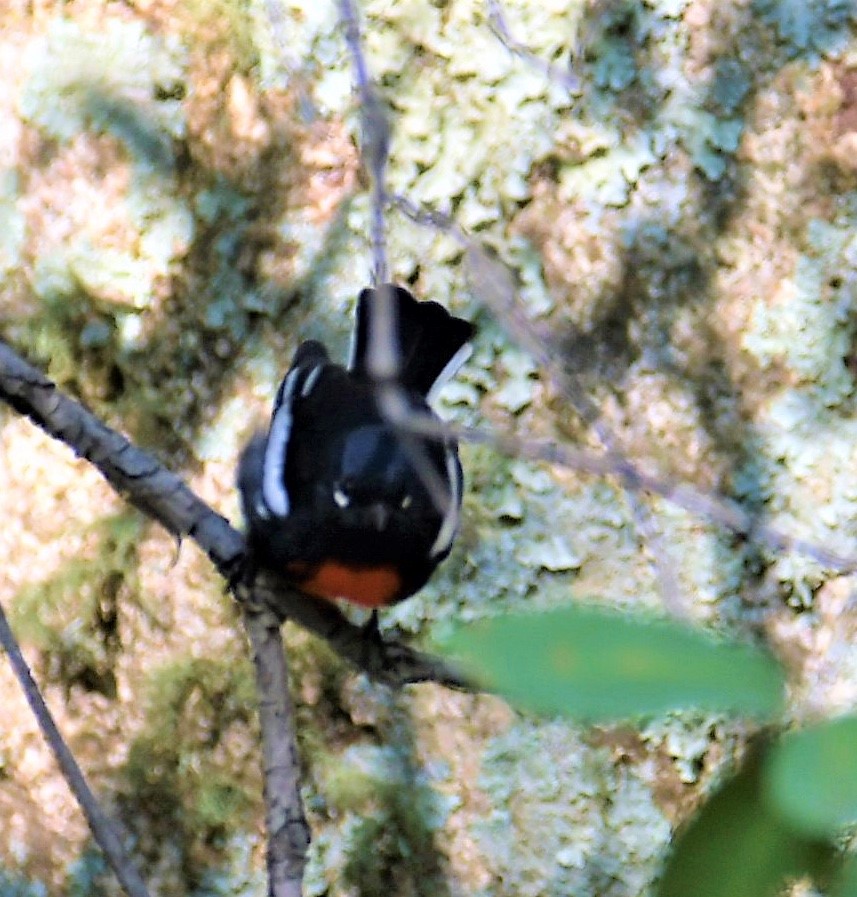
We hadn’t made it to the spring yet when a Jay finally gave me a chance for a photo. And turning to head back up the trail there it sat, a Male Elegant Trojan! Resplendent in his Red vest, azure Blue top coat and Green tail. He appeared with his back to us, then sensing our presence flew to a nearby tree where we could see his red vestment. Birders from all over America and across the globe come here hoping to get their sights on one. My first sighting, Suzanne’s second. Wow! Elated by his appearance we watched him for some time before deciding to move on. We passed by the Spring and stopped to catch our breath. A couple hundred yards ahead a Painted Red-start crossed our path and flew down into the wash that dropped down from the trail and separated our mountainside from the one on the other side. Playing hard to get it would land with its back facing us then quickly fly a few feet ahead or backwards at it’s whim. We followed it back and forth trying to capture its red breast in a photo. Just as it landed, red flashed. Suzanne positioned her camera, I glanced across to the mountainside opposite, “ah, Suzanne, there’s a BEAR over there!” “ A BEAR”, Yep, there it was, a cinnamon colored, healthy, adult Black Bear sniffing a bush.
I had one quick thought that if the bear had wanted to it could be on us in less than a minute. But, instead it turned away and began walking away, up the hill. A couple of steps, it turned and gave a Harumpft! …..darn humans! I snapped several photos and together we giggled with joy!
We had been standing in this same spot not 2 minutes before and there was no bear. Had it not been for that crazy Painted Red-start we never would have seen it. It seemed unimaginable, seeing a real live bear and an Elegant Trogan minutes apart. Mother Nature had smiled on us! An unbelievable day!
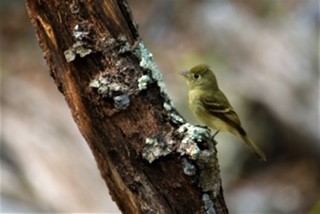
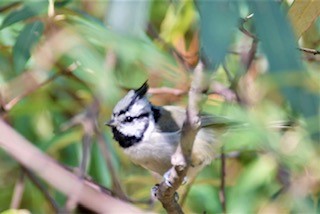
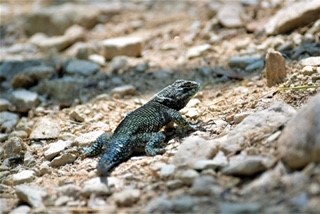
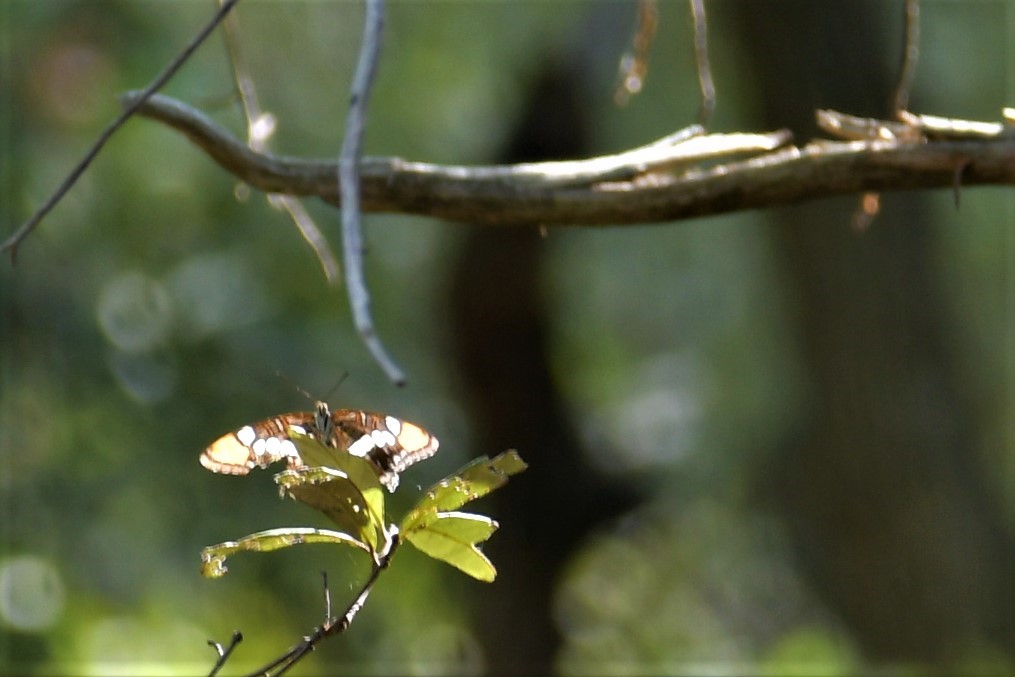

Cohort Connections: The Raptor Protection Program
Submitted by Tori West (Cohort 3), October 2020
So many people loved my husband’s photo of the fire and the owl on the telephone pole in the last newsletter and on Facebook, that I began thinking it would be nice to share a story about that pole, another pole on our property, photographs, and a wonderful connection made on my journey to become a master naturalist.
As we all know, a large part of the AZMN program is learning how to work together in groups. I met the members of my first Cohort 4 group in mid-February and was very happy with the people I would be working with on our first field lab and assignments! As we talked a bit and got to know each other I asked one of our members, Starlight Noel-Armenta, about her job. She said she investigated power poles to find out if they were safe for raptors and provided the information to Tucson Electric Power (TEP) so the poles could be properly insulated. I was really interested in this as my husband and I spend a great deal of time enjoying the wide variety of wildlife that entertains us on the poles we have on and near our property. I can honestly say it never occurred to me that the poles weren’t safe, because although many years ago I had heard that power poles could kill wildlife, I thought the poles had to have some worn out or faulty wiring to be dangerous and the electric and phone companies had already taken care of this. I suppose I didn’t put a lot of time in to thinking about the fact that all of the old ones needed to be modified.
We not only enjoy watching wildlife in our area, we like to take photographs when we are able. My husband, Steve Weller, has become particularly good at this, so the day after my conversation with Starlight, I sent her the following photos and asked if she could tell from these close-ups whether or not our birds were in danger.
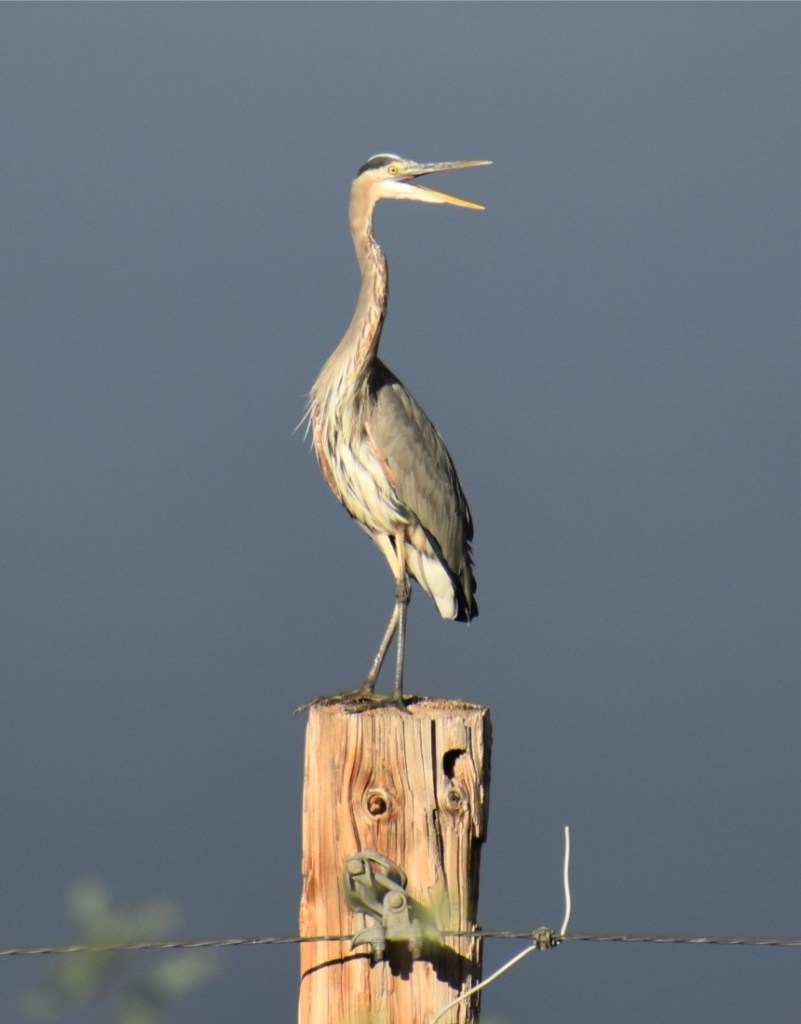
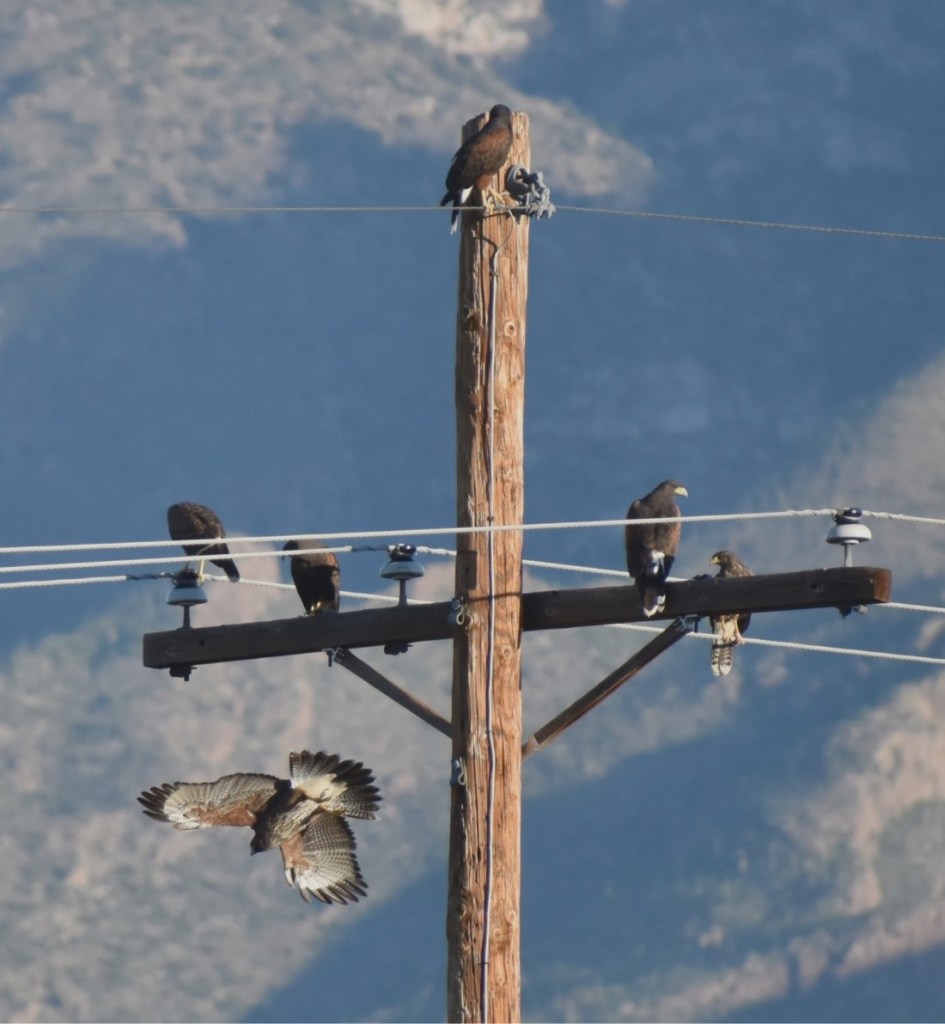

As you can see, we have quite the variety of pole visitors. Six hawks on one pole is not an unusual sight, and sometimes there is an additional group on the pole next in line!
Starlight could tell from the photos that our lines needed insulation. I told her where I had seen hawks nesting not far from me, so she made a trip out my way to scope out the area checking for poles in need of work and looking for nest sites. Although she didn’t find any nest sites, she did mark 5 poles along that line that needed modifications and submitted her report to TEP.
TEP has many poles to attend to, so we had no idea when the modifications would be made but were glad that it would be taken care of as soon as they could arrange it.
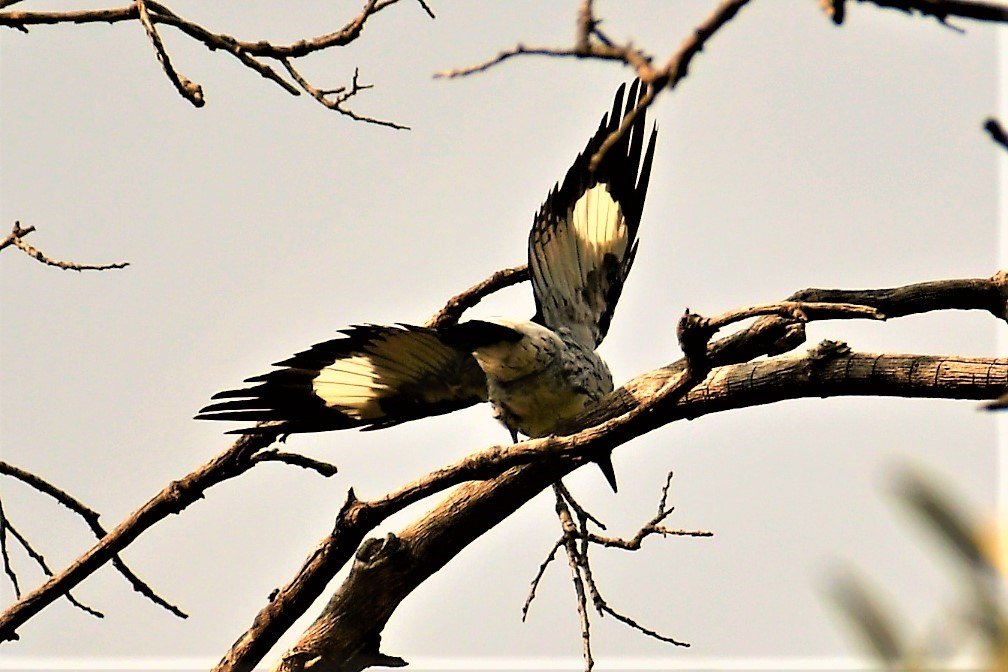
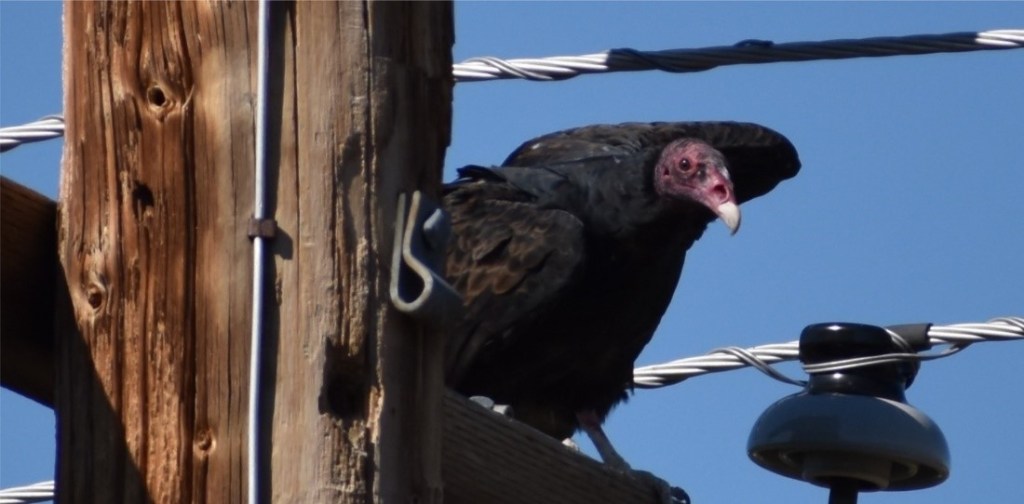
On May 20th, coincidentally the day after I attended the “Unlovable Vultures” presentation from the Arizona Game and Fish Department, we woke to find this beauty on the pole.
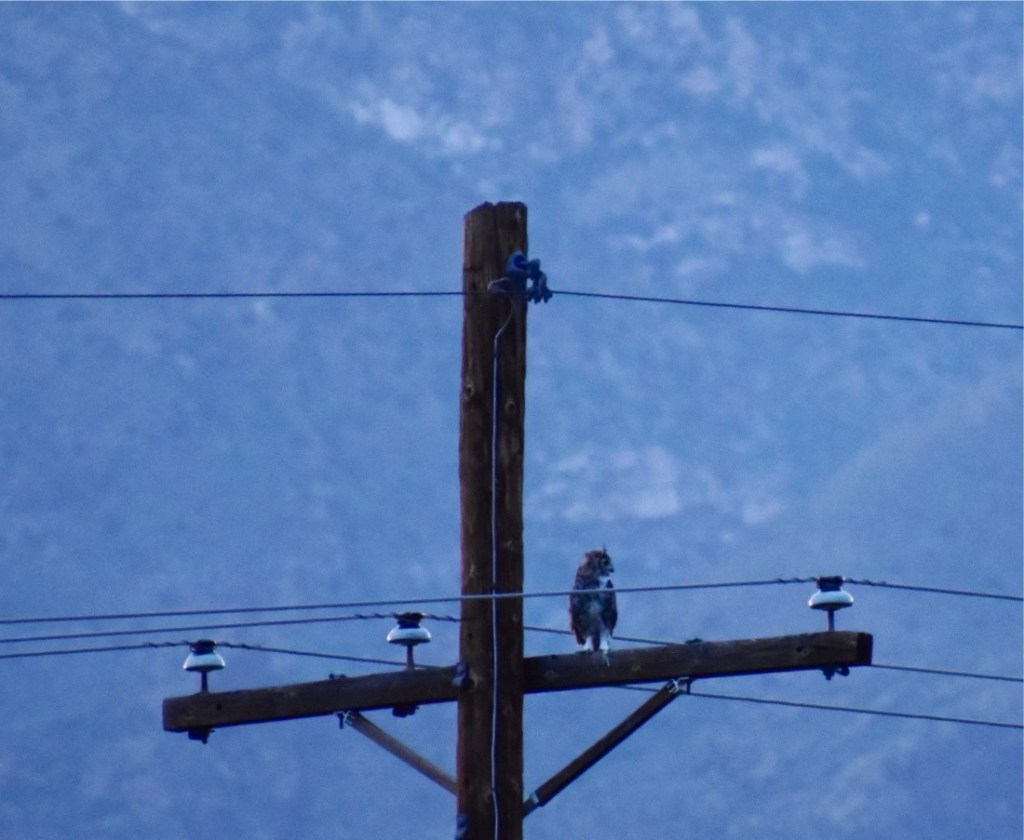
We weren’t sure if the poles had been insulated or not, but later that same day Steve took these photos
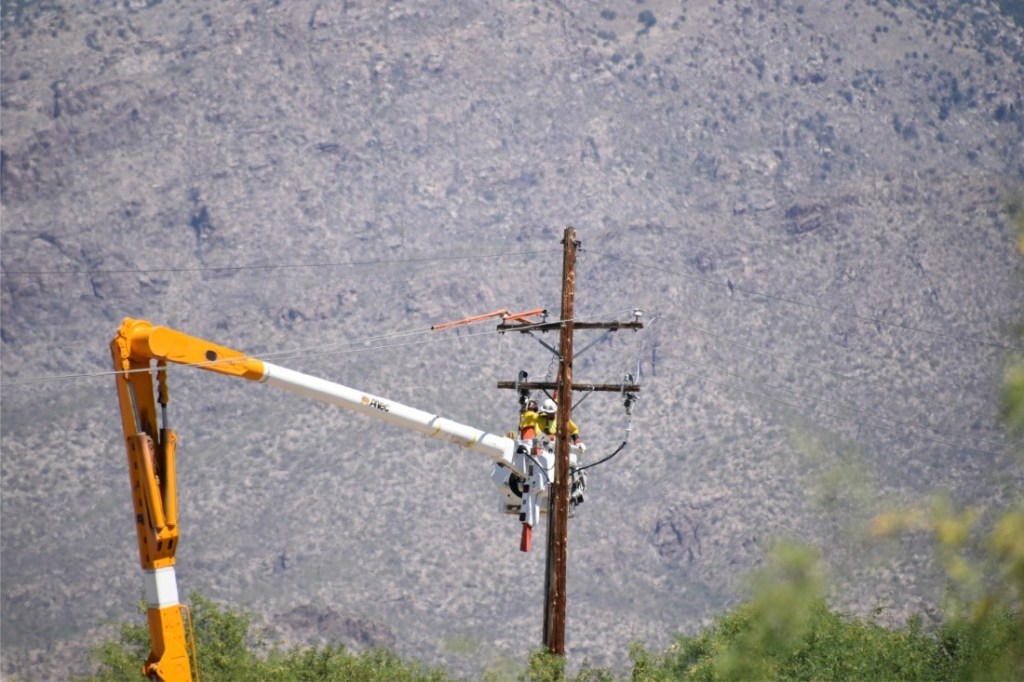
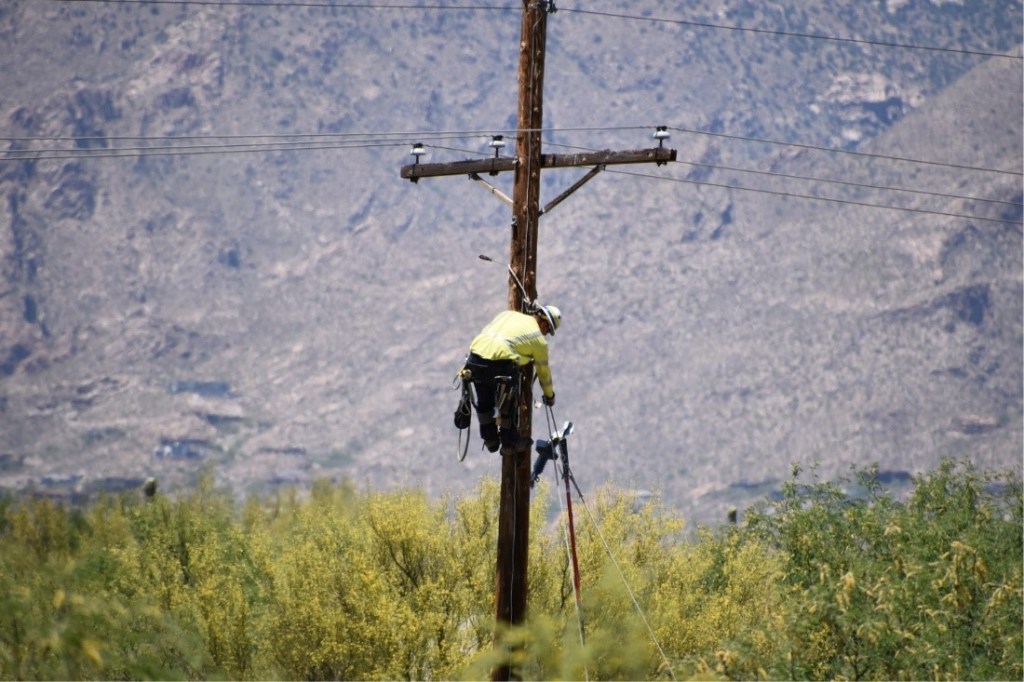
I am so thankful for getting to meet Starlight in Cohort 4, and for her help in making our favorite bird viewing posts even more enjoyable knowing that the birds are safe!
Here is some more information Starlight provided about the details of her work and the TEP Raptor Protection Program.
The Raptor Protection Program is a collaborative effort between the University of Arizona and Tucson Electric Power Company which is designed to reduce the number of hawks and owls electrocuted on Tucson’s overhead distribution system. The program began over 20 years ago when it was discovered that the social breeding system of Harris’s hawks nesting in Tucson was being negatively affected by the electrocution of key members of breeding groups.
Starlight works in the University of Arizona School of Natural Resources and the Environment, under the supervision of Dr. Bill Mannan. Dr. Mannan’s research has focused on the effects of urbanization on the population dynamics of predatory birds. Research projects done by his past graduate students have been key drivers in the initiation and development of the Raptor Protection Program.
(As a side note, Steve has found another avenue for some of his photos due to another of my cohort 4 team members, Rebecca Lipson, who started the Tucson Neighborhood Naturalist project on iNaturalist!)
WATER FLOW MONITORING ON BIG WASH
Diana Holmes, Pima County Master Naturalist, Cohort 2
September 2020
Like many of the master naturalists, I participate in several citizen science efforts, one of which is a water flow monitor for the Watershed Management’s River Run Network. I monitor Big Wash located in Oro Valley, Arizona west of North Oracle Road. The wash typically flows after rain events and is primarily fed by the drainages from the Tortolita Mountains. It eventually discharges into the Canada Del Oro Wash, a major tributary of the Santa Cruz River. The wash is a braided channel that is divided into smaller channels. These channels are a network of streamlets which diverge and rejoin.
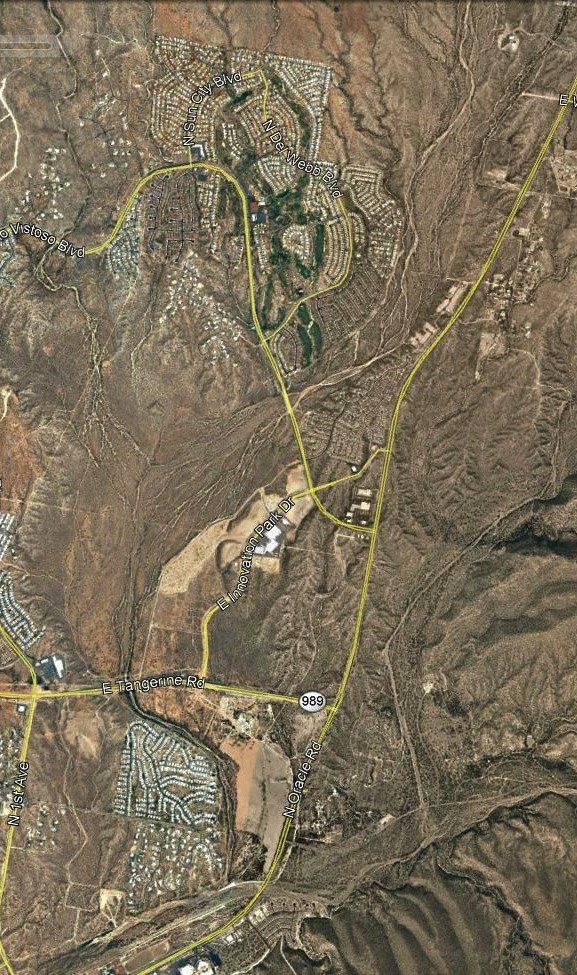
This photo shows Big Wash on the right joining with the Honeybee Canyon Wash on the left. My monitoring site is located at the Rancho Vistoso Boulevard Bridge which spans the wash. I take photos and make a report on the Water Reporter App, a social network optimized to support watershed initiatives in communities working to protect and improve water quality.
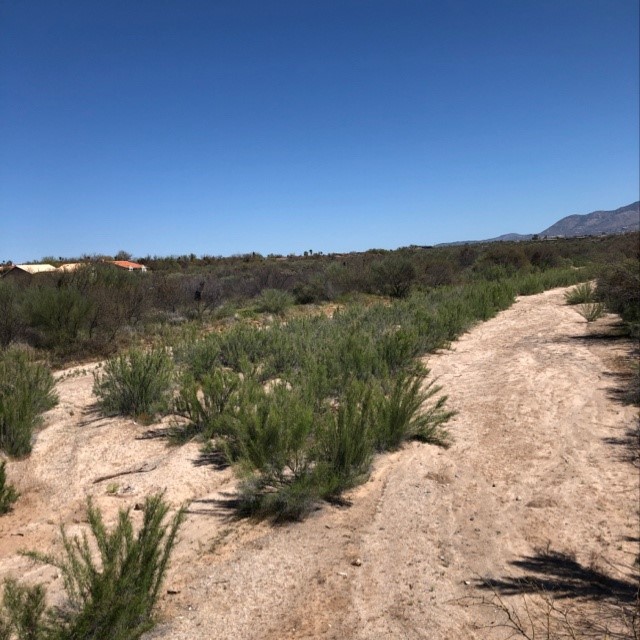
Dry wash
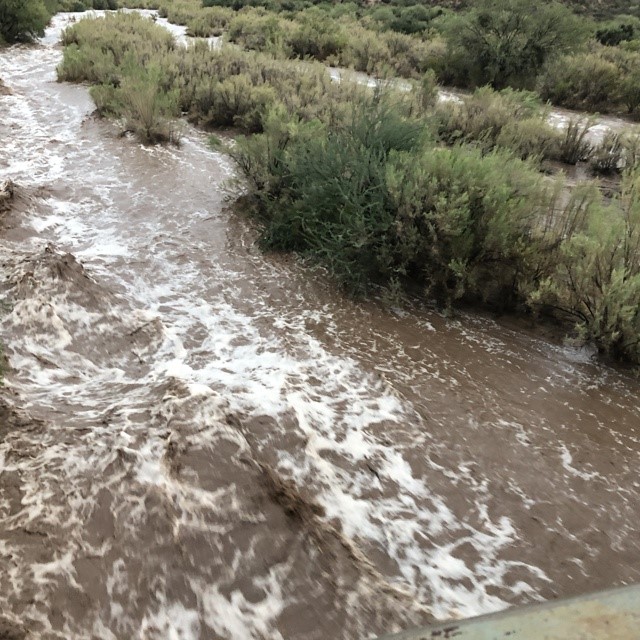
Rain event

One day after rain, note the ash residue from the recent fires upstream.
A friend and I hike the wash during the pleasant fall and winter months. We see animal tracks, birds, many rodents, interesting rocks and driftwood that have washed down from upstream and, unfortunately, tires and other trash. I make notes and report any unusual or illegal activity such as motorized vehicles or their tire tracks in the wash. We’ve crunched through ice and snow and we lookW for changes in the wash since our last visit.
The River Run Network is looking for volunteers to monitor washes around Pima County. If you have an interest in participating in this important volunteer citizen science activity, contact:
Lauren Monheim, Program Coordinator, River Run Network, Watershed Management Group lmonheim@watershedmg.org
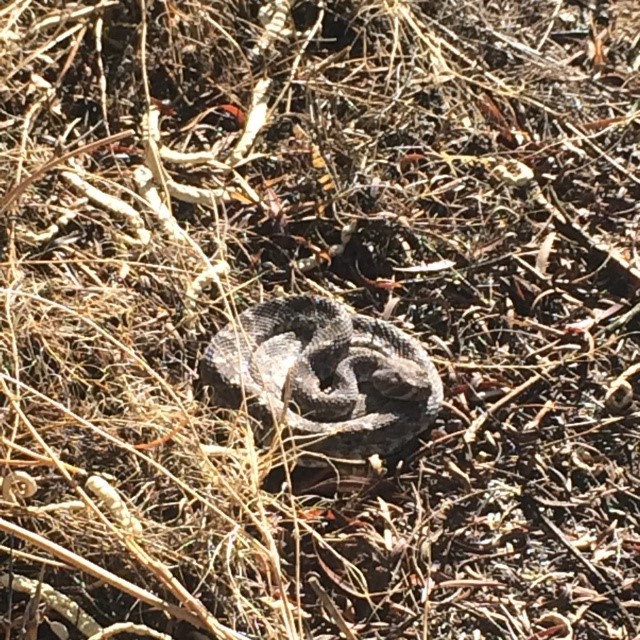
Western Diamondback Rattlesnake on the trail
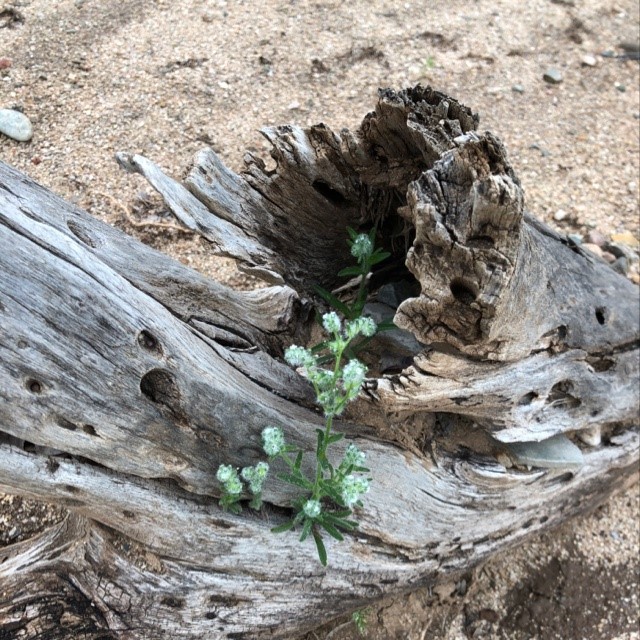
There is always something interesting to see in the wash. This plant was growing out of a crack in the driftwood.
A Canid That Can Climb Trees
Capstone Project created by PCMN Jan Schwartz, 8/13/20
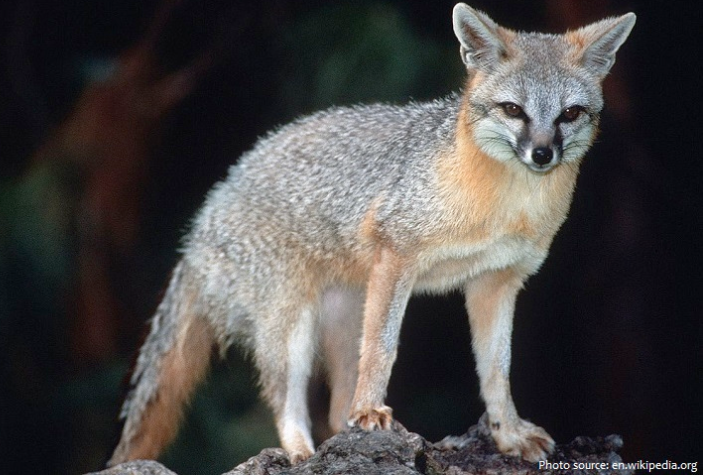
That would be the gray fox! Who knew? This fox has very strong hook-like claws and flexible wrists, which allow it to climb trees. It uses the tree as a place to sleep, to escape predators, and also to find food. They’ve also been known to take their prey up into the trees to eat in peace.
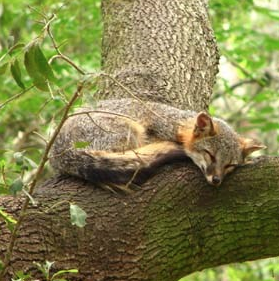
The gray fox dens in the ground (in a stolen den from another animal), in the hollow of a tree lower to the ground, and if they find the right tree with the right branches they will also den up high. The gray fox raises its young in the den until they are about 4 months old. Once the pup reaches that age, its teeth are mature and it can start to forage for itself.
A solitary hunter, the gray fox plays an important part in keeping small rodents in check. They eat rabbits, insects, and lots of fruit when it’s available. And also, of course, small rodents.
The fox protects itself by climbing trees and by clawing at predators with those strong, sharp claws; they communicate by barking, growling and sometimes squealing; they are primarily nocturnal; and they are relatively small animals weighing in between 8 and 15 pounds and standing 12 to 15 inches tall.
Now, I wonder when I’ve hiked in the evening if those eyes I saw in the trees belonged to an owl or a gray fox!
Las Cienegas Day Trip
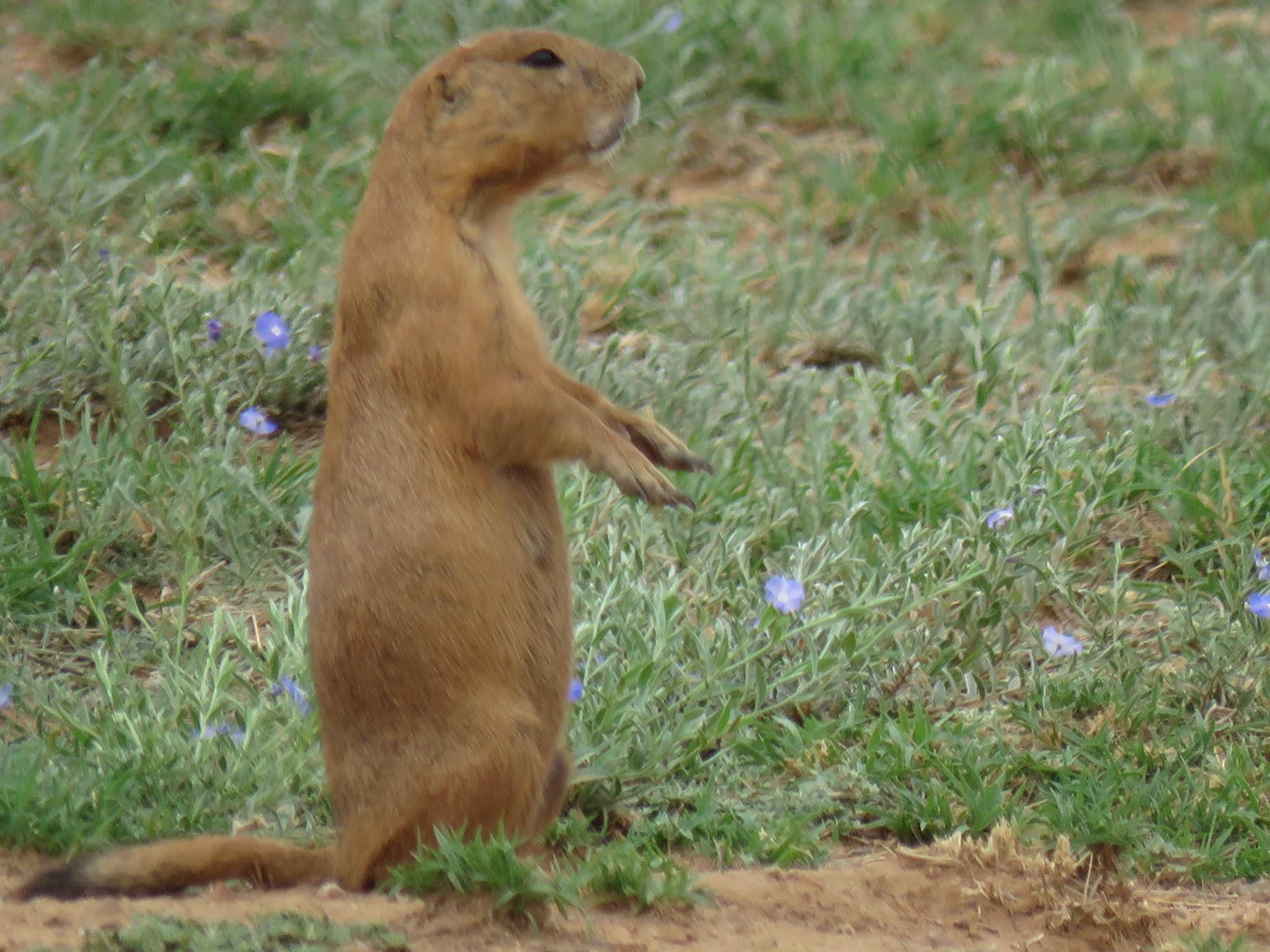
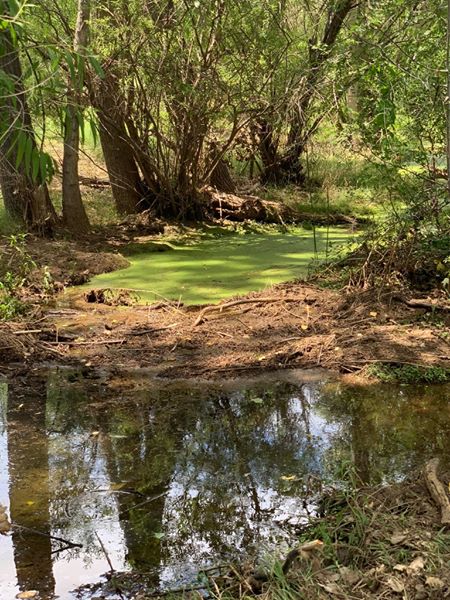
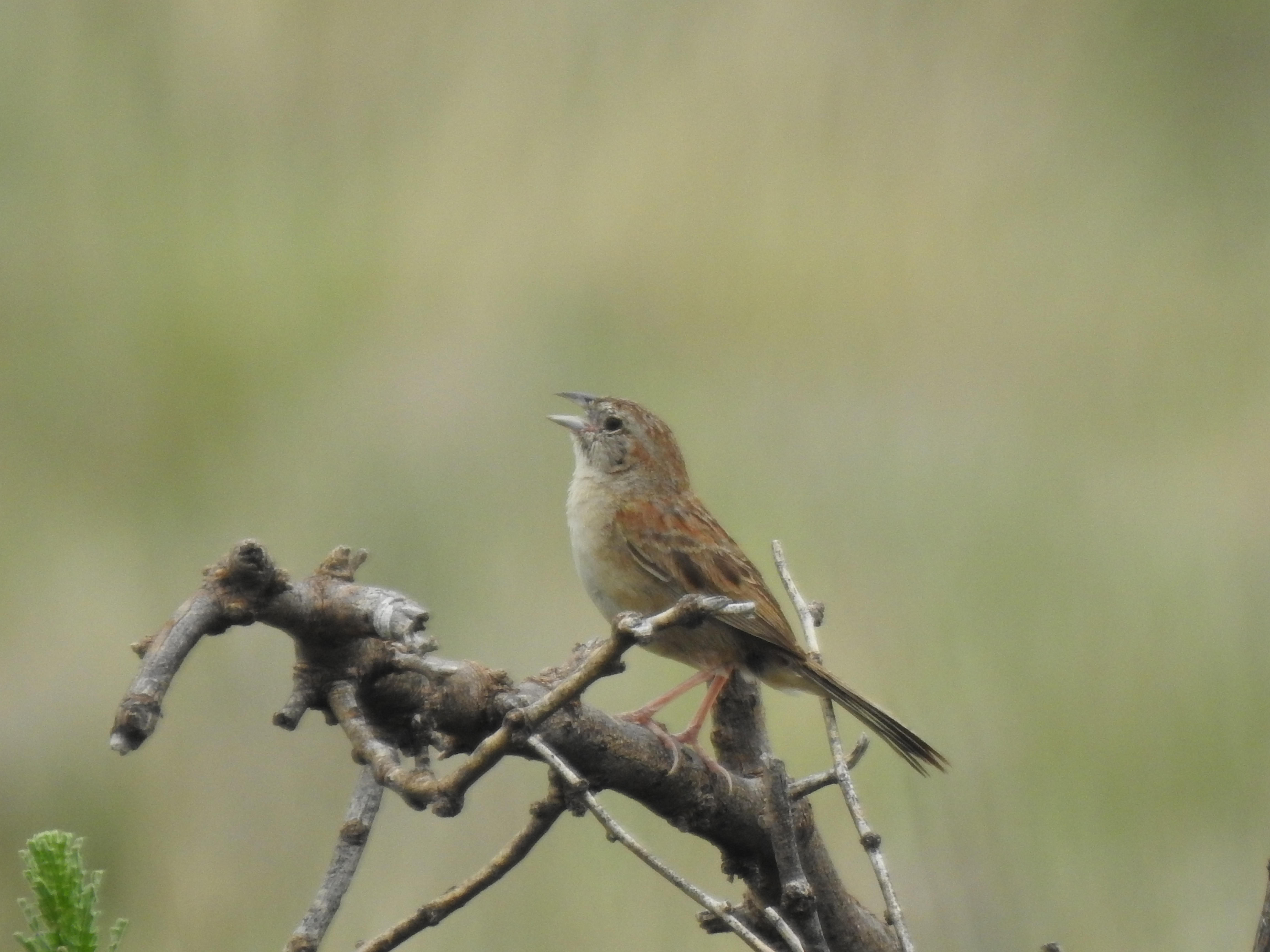
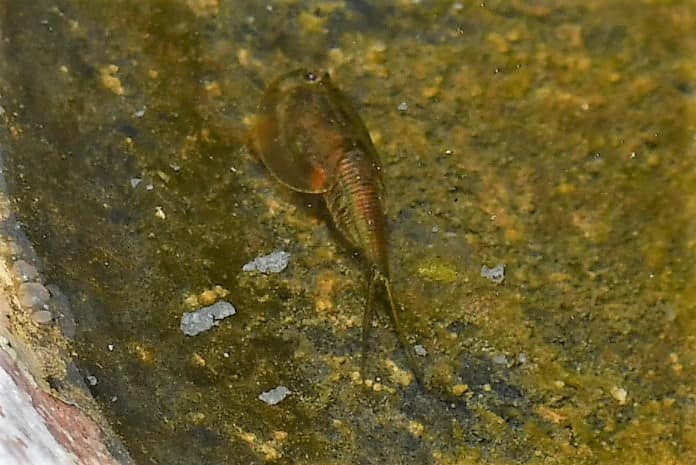 By Kathy Mclin: I spent an incredible day in nature at the Las Cienegas National Conservation Area, Empire Ranch, along with friends and fellow Master Naturalists, Peggy Ollerhead (C3) and Debbie Petrich (C1). We took off at 6am and before 7 we arrived on the property. The meadows were lush with the songs of botteri sparrows and kingbirds. The biggest Red-tailed Hawk I’ve ever seen greeted us at the Ranch entrance. Unfortunately a car in a hurry, roared by my stopped car before we could take a photo. Can you believe it! I forgot my camera at home. Had all the lenses and my camera bag but no camera. We dined in a riparian glen where water from a recent monsoon rain left streams full of succulent water cress and a large patch of mint. I packed salads for our lunch which I garnished with fresh water cress.In the parking area were canid tracks and all around our dining area were ‘cat’ and deer tracks. Not more than 12 hours old by the looks of them. The temperature was between 75 and 85 degrees all morning, absolutely perfect! And in the puddles of the parking area there were tiny tadpoles swimming around. Perhaps little leopard frogs to be if the grow really fast! And, we visited a blacktail prairie dog colony! I love these vocal and endearing little dogs! Update: some of the tadpoles looked like little horseshoe crabs and, after research, we discovered they were tadpole shrimp. Check this blog post for an update on the tadpoles. – Submitted by Kathy Mclin (C3)
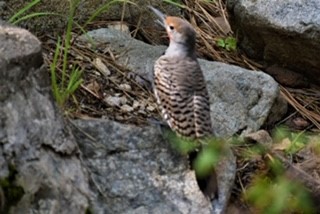
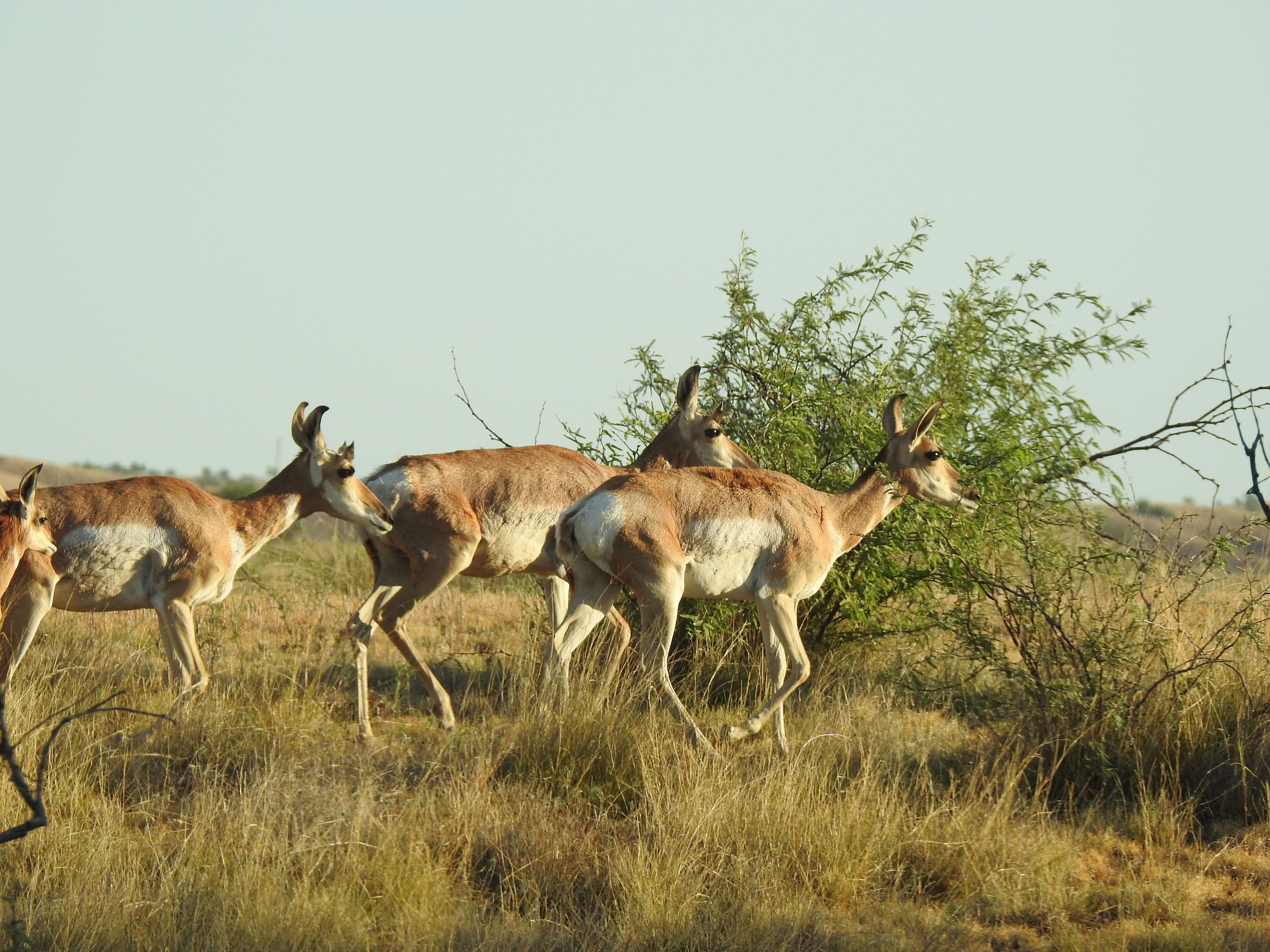
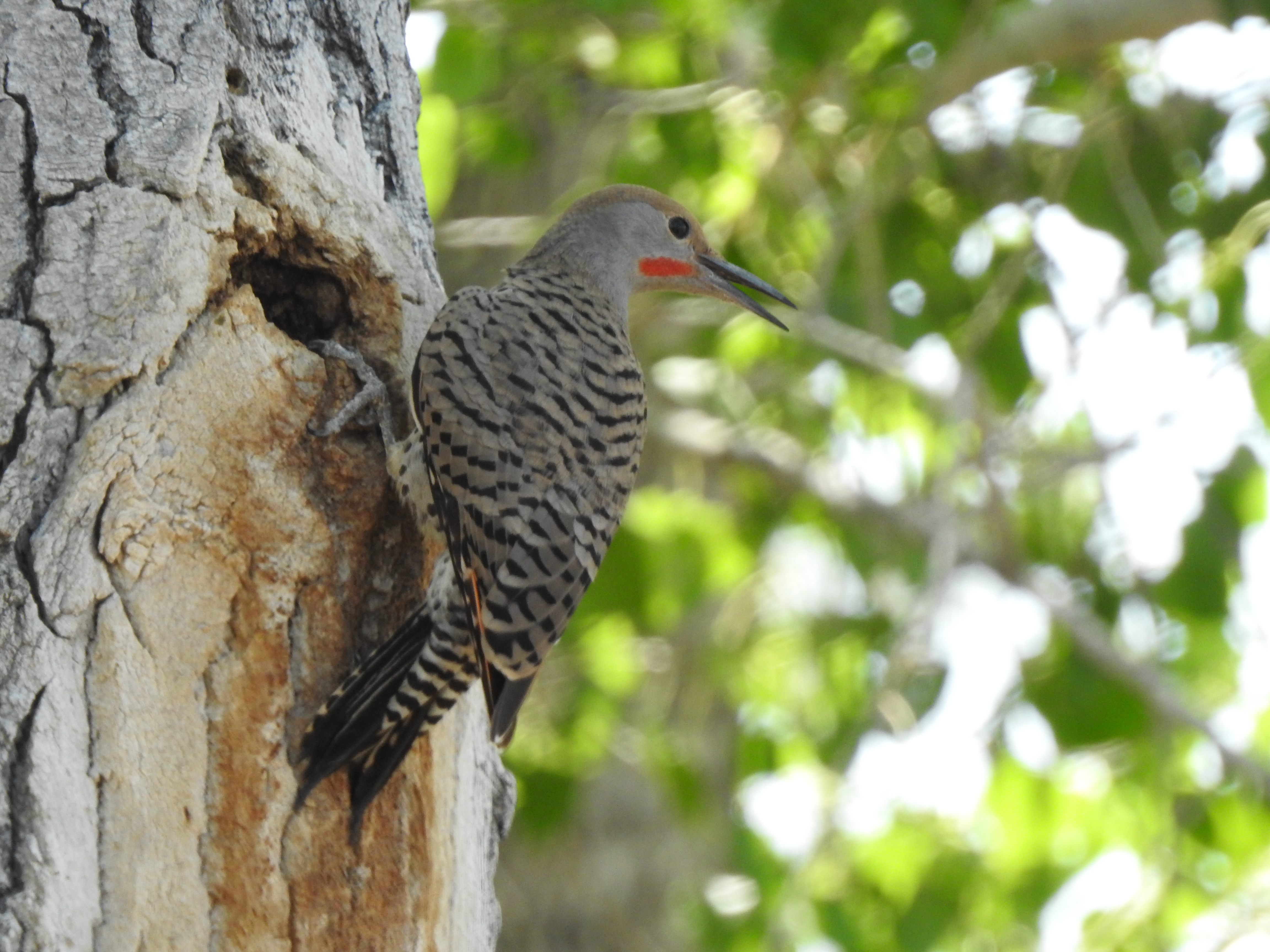
@Addendum from Deb Petrich (C1): Thanks to Luke Safford from the Tucson Audubon Society for putting this spot on our map for birding in his July webinar. For you birders out there, here’s a list of some of our observations: Botteri Sparrows, various Vlycatchers (Vermillion, Black and Say’s Phoebe, Brown Crested), Kestrels, Prairie Falcons, Red Tails, Swainson’s and Gray Hawks, Killdeer, Summer Tanagers, Black Throated Sparrows, Cassin and Western Kingbirds, Lark Sparrows, Black Headed and Blue Grosbeaks, Northern Flickers, Orioles, Loggerhead Shrikes, Gila Woodpeckers and a Wild Turkey to name a few.. White tailed deer and a family of Pronghorn were also spotted.
Photos: Deb Petrich (C1) and Kathy Mclin (C3)
 Pima Master Naturalists
You must be logged in to post a comment.